
West Elm Dupes on Amazon: 8 Worth It, 2 to Skip (2026)
Updated: 11 hours ago
This post contains affiliate links. As an Amazon Associate I earn from qualifying purchases. If you purchase through these links, I may earn a small commission at no extra cost to you. I last updated this page in October 2026. The ten-month owner feedback below was collected in July 2026. Amazon prices change all the time, so the numbers I give are rough - always check the current listing before you pull the trigger. West Elm prices swing a lot with sales and fabric choices, so those are ballpark numbers from their site too.
In September 2025 my younger brother moved into his first real apartment. He's a student, his budget for furnishing the entire place was about $1,800, and he has expensive taste - specifically, he'd been saving West Elm photos for a year. Walnut, clean lines, bouclé, the whole warm mid-century thing. The problem is that at West Elm, that living room and bedroom would have run somewhere north of $9,000. A sofa alone could eat his entire budget.
So I did what I apparently do now: I turned his apartment into a project. I picked every single piece myself, all of it from Amazon, all of it chasing specific West Elm designs. And because I can't help myself, I've been checking in on him every few weeks since - what's holding up, what's sagging, what he'd buy again. Ten months later, I have real feedback on every item in that apartment, including the two things we had to send back.
Don't see the West Elm piece you have in mind? I find dupes for specific pieces on request through my Dupe Finder service.

That's what this list is. Not "here are twelve links I found last night" - the eight pieces that survived ten months of student life, what each one is actually like to live with, and the two categories I'm telling you to walk past no matter how good the photos look. One thing to be clear about up front: none of these are counterfeits. They're independent pieces that openly borrow the West Elm silhouette - the shapes, the proportions, the finishes. The skill is knowing what West Elm actually charges for (kiln-dried hardwood frames, real walnut veneer, top-grain leather) and what you can copy for a tenth of the price (a silhouette, a bouclé texture, an arc of metal). I'll flag which is which on every piece. And if you're still deciding whether West Elm itself is worth paying for, I did that math brand-by-brand in my Castlery vs Article vs West Elm comparison.
The best West Elm dupes on Amazon, at a glance
If you came for the list, here it is. Every piece below has been lived in for ten months, and the full review of each one is further down the page.
West Elm Harmony sofa dupe: GNIXUU 76.7" L-Shaped Chenille Loveseat with Ottoman, about $414
West Elm bouclé chair dupe: Zihanhome Bouclé Swivel Barrel Chair, about $300
West Elm media console dupe: mopio Ensley 59" Media Console in walnut, about $257
West Elm drum coffee table dupe: JOINICE 31.5" Fluted Drum Coffee Table, about $160
West Elm arc floor lamp dupe: CO-Z 69" Arc Floor Lamp with marble base, about $120
West Elm nightstand dupe: HAIOOU Mid-Century Nightstands, $90 for the pair
West Elm rug dupe: Nakagishi 5x7 Washable Moroccan Rug, about $25
West Elm bed frame dupe: AMERLIFE Solid Wood Full Platform Bed, about $210
The two I would skip, a sub-$150 fluted sideboard and an $80 "bouclé" desk chair, are near the end with the reasons.
How I picked these West Elm dupes on Amazon
Most West Elm dupe roundups are written by people who never opened the box. I had a stricter filter, because every one of these had to survive an actual twenty-two-year-old.
First, it had to pass across the room. A dupe earns its keep at six feet, not six inches - if the silhouette and finish read right when you walk in, it works. Second, it had to pass my usual materials check - I put every candidate through the same process I use on everything, the WarmCazza knock test, which is mostly about not letting a nice photo talk you out of reading what something is made of. Third, I went looking for pieces with enough reviews to show age. I don't care how a chair looks on delivery day; I read the three-star reviews from people eight months in, because that's where sagging cushions and peeling veneer show up. And fourth - this one's specific to furnishing a student - it had to survive a future move. He will not live in this apartment forever. Anything that couldn't be disassembled and rebuilt without dying got cut.
A lot of good-looking stuff failed one of those four. These eight didn't.
West Elm Harmony sofa dupe: the look for a fifth of the price
West Elm's Harmony is their bestselling sofa for a reason - deep seat, low wide arms, that sink-in casual shape - and depending on size and fabric it runs roughly $1,700–$3,000. It was the piece my brother wanted most and the one that was never going to happen at retail.
What I bought him instead was the GNIXUU 76.7" L-shaped chenille loveseat with ottoman in camel, about $414 at the time of writing, and I've seen it listed as high as $460, so watch for the dips. The proportions are the whole trick: a 25-inch-deep seat, low arms padded with big loose pillows, and loose back cushions rather than tufting, which together give you the sink-in posture the Harmony is famous for. In a dim room with a throw on it, it reads Harmony. In daylight, up close, you can tell the difference: the cushions are two layers of high-density foam, not the down blend West Elm wraps its cushions in, and the listing doesn't say what the frame is made of, which by my own rules means assume it isn't kiln-dried hardwood. That's exactly where the missing $1,300 went, and for a first apartment I'd skip paying for it every time. The flip side is worth saying plainly: if you're furnishing a place you'll still live in at year six, the sofa is the one category where I'd tell you to wait for a West Elm sale and buy the real frame instead, because construction is the thing a sofa is.

Ten months of his feedback, condensed: it's the most used object he owns, and the foam cushions have held their shape better than I expected at this price. They gave a little in the first two months and then stopped. Rotating them once a month (I made him set a reminder) has kept them from developing a permanent "his spot." His one complaint is that the seat cushions creep forward if you sit on the very edge, and a strip of non-slip rug liner underneath fixed it for about six dollars.
Three practical notes. It's a loveseat at 76.7 inches wide, which for a first apartment is the right call, because an eight-foot sofa in a small living room is a wall, not furniture. With the ottoman pushed into the L it's 57 inches deep, so measure that footprint, not just the width, and leave 30 inches minimum to the coffee table or the room stops working. And it's modular: the pieces buckle together without tools, arrive in two boxes, and come apart again, which is the best possible news for a student who will be carrying this down a staircase at least once.
West Elm bouclé chair dupe: the trend piece that held up
Every West Elm-style room on the internet has a bouclé chair in it right now, and West Elm's swivel versions run roughly $900–$1,300. This was the piece I was most nervous about duping, because cheap bouclé is where budget furniture goes to embarrass itself.
The one that worked is the Zihanhome bouclé swivel barrel chair in green, around $300.
The barrel shape is what sells it - that wraparound curved back is very hard to make look cheap - and the swivel base means it works angled toward the sofa or spun toward the window. What made me pick this one over a dozen cheaper options is the fabric: it's a proper looped bouclé, not the flat "sherpa" or "teddy" fleece that most listings in this category pass off under the same word. That's the single thing to check before you buy anything in this category, and I'll say more about why in the skip section below.
His ten-month report: still his favorite thing in the apartment and the chair every guest goes for. Two honest wear notes. The bouclé pilled slightly on the right arm, exactly where his backpack strap drags across it daily - a $12 fabric shaver took it off in five minutes and it hasn't come back. And a swivel base of any kind will mark a hardwood floor if you spin it enough; a felt pad underneath solved that on day one, so put the pad down before the chair, not after the mark. If you're weighing bouclé against other upholstery for something that gets daily abuse, I broke the whole durability question down in Bouclé vs linen.

West Elm media console dupe: the famous one
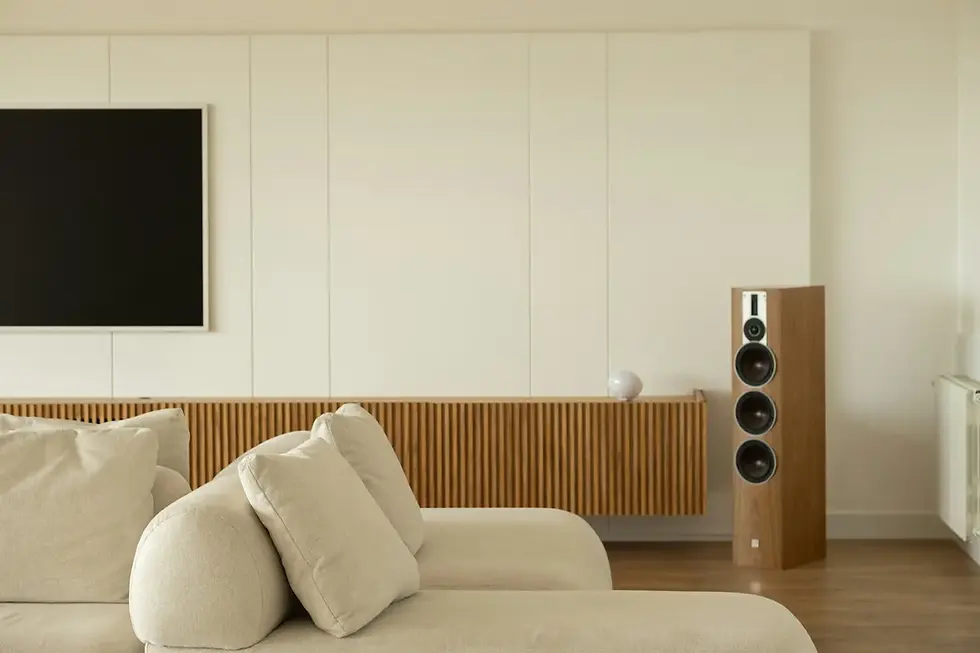
If you've seen one West Elm dupe go viral, it's this category - West Elm's ribbed-front media consoles run around $1,600–$1,800, and the Amazon versions became a whole genre on TikTok because the resemblance is genuinely absurd for the price gap.
I got him the mopio Ensley 59" Media Console in walnut for about $257. It's a slatted front rather than a fluted one - horizontal ribs instead of vertical - and honestly it's the version I'd pick anyway: the slats plus the warm walnut tone and the four tapered legs are what make it read mid-century from across the room. The honest part: this is walnut laminate over engineered wood, not solid timber. That means two rules. Don't drag it - lift it, because engineered corners chip and can't be sanded back the way solid wood can. And anchor it to the wall; it's not furniture-tips-over heavy like the real one, which is a feature on moving day and a risk the rest of the year.
His feedback has been almost boring, which is the best review a TV stand can get. The cutout in the middle of the back panel swallowed the router-console-TV nest completely, and the two adjustable shelves meant he could fit a console vertically without a fight. The one design trade-off worth knowing: the doors slide rather than swing, so you can only ever reach half the cabinet at a time. Put the things you grab daily on the side you leave open. Ten months in, the finish has one small chip on a back corner from the day we assembled it, and nothing since.

West Elm drum coffee table dupe: fluted, with hidden storage
West Elm's sculptural coffee tables - the drum and pedestal shapes - sit roughly in the $500–$800 range, and they're one of the fastest ways to make a room look designed instead of assembled. The dupe that made the cut is the JOINICE 31.5" Fluted Drum Coffee Table with storage, around $160. I picked the drum shape on purpose for a student apartment: no corners to catch a shin during a game night, a solid visual anchor for the room, and at 41 pounds one person still slides it aside when people come over. It reads as one sculptural piece rather than four legs and a slab, which is most of what you're paying West Elm for - and the bun feet and vertical fluting are doing a lot of quiet work there.
The part I didn't expect to matter as much as it does: the top flips open and there's a sliding tambour door in the side, so the whole drum is storage. In an apartment with no closet to speak of, that table swallowed his blankets, chargers, and the entire junk-drawer category of objects that otherwise live on a coffee table and make a room look chaotic.
Real-life report: the walnut finish wipes clean, which for a surface that has hosted more drinks than any piece of furniture should is the review that counts. Two honest notes. Fluting collects dust in every groove, so it wants a dry brush or a vacuum attachment every few weeks - a wipe-down won't reach it. And keep the tambour track clear; a sliding door is smooth right up until something small drops into the channel.

West Elm arc floor lamp dupe: the biggest return per dollar
West Elm's arched floor lamps run roughly $400–$600, and I'll say something slightly unfair: lighting is the easiest dupe category there is, because nobody inspects a lamp. They see a shape and a glow.
The CO-Z 69" Arc Floor Lamp with marble base was about $120, and per dollar it did more for that apartment than anything else on this page. The arc reaches almost three feet out, so the light lands over the sofa without a ceiling fixture - which matters, because the apartment came with one grim overhead light - and the marble base is real stone at 14 pounds, heavy enough that the thing does not tip while taking up about a foot of floor. The height adjusts between 59 and 69 inches and the dome shade rotates a full circle, which is how he ended up angling it over the bouclé chair for reading instead of the sofa.
The trick is entirely in the bulb. The included LED is 3000K, which is warm enough out of the box - but if you want the deeper amber West Elm photographs in, swap in a 2700K bulb for a few dollars and never touch the ceiling light after sunset. That one choice is the difference between "student housing" and a room that looks like it was lit on purpose. His feedback: guests keep asking where the lamp is from, and he's developed the smug pause of a man about to say "a hundred and twenty dollars." The only assembly note is that the arm arrives in sections and the connections want a firm push - a wobbly arc means a joint isn't seated, not a defective lamp.

West Elm nightstand dupe: a mid-century pair for $90
The best West Elm nightstand dupe I have found is the HAIOOU Mid-Century pair: $90 for both, tapered solid pine legs, a single drawer with a slim black pull, and a charging station built into the top. It copies West Elm's Mid-Century nightstand rather than the Parker, and after ten months both drawers still close straight.
There are two West Elm nightstands people actually search for. The Mid-Century is the one everyone pictures: tapered legs, a recessed drawer front, acorn finish. The Parker is the same idea in a squarer, slimmer body, and it's the one I get asked about most. Both run about $400–$500 each, which is a genuinely hard number to say out loud about a nightstand.
Ninety dollars for the pair is the most absurd line in this whole article, so here is why it holds up. The legs are black solid pine, the proportions don't read bloated, and the body is a walnut wood-grain finish over engineered board, which at nightstand scale honestly doesn't matter. The one detail that trips people up is the drawer. It sits flush with the case, which is technically a Parker trait, but the legs decide which line a nightstand reads as. The Mid-Century's tell is the taper: legs that narrow toward the floor and sit at a slight splay, which is what softens the box above them. The Parker's tell is the opposite, a straight leg under a squared case. The HAIOOU has the taper, so it lands squarely on the Mid-Century side. At 13.7"D x 17.7"W x 24.4"H it also sits close to West Elm's proportions, which is what most cheap nightstands get wrong: budget versions run tall and narrow, and a nightstand that stands above your mattress top reads wrong no matter what it's made of. Measure your bed height before you order anything in this category.
The feature that turned out to be the point: there's a built-in charging station on the tabletop with AC outlets and USB ports. His bedroom has exactly one outlet, behind the bed, which is the standard cruelty of old apartments - so the nightstand became the place everything charges, and the extension cord that was going to live on the floor never happened.
His notes: assembly took about forty minutes for the pair, and the drawer glides felt gritty for the first week - a rub of candle wax on the runners fixed it permanently, an old trick that works on every budget drawer ever made. One honest limit: these are rated for about 22 pounds on top, so a lamp, a book stack, and a glass are fine, but this is not the surface for a small TV or a stack of textbooks. And the upgrade that makes them read custom, same as I said about the RH nightstands: swap the stock pulls for real brass. Twelve dollars, five minutes, and with the black legs you land exactly on the brass-and-black palette the rest of the room is using.
The Parker is a harder dupe than the Mid-Century, and it's worth knowing why before you go looking. Tapered legs hide a lot. They break up the box, so a mediocre case above them still reads fine. The Parker has no taper to hide behind. It's a plain rectangle on straight legs, which puts every proportion and every edge on display, and that is exactly the shape where foil veneer and soft engineered-board corners show up.
So the checks change. Look for a squared leg in solid wood rather than a tapered one in anything, because on a straight-legged piece the leg is a visible line and a painted metal one reads as office furniture immediately. Check that the drawer front sits flush with the case sides rather than overlapping them, since that flush front is most of what the Parker is. And read the shipping weight: a two-drawer nightstand this size that arrives under twenty-five pounds is hollow somewhere, and on a boxy silhouette you will see it.
If you can't find one that passes all three checks, buy the HAIOOU pair and swap the pulls. Two good nightstands in the wrong West Elm line beat one bad nightstand in the right one.

West Elm rug dupe: washable beats plush
West Elm's 5x8 rugs run roughly $600–$1,500, and they are beautiful, and putting one in a student apartment is an act of self-harm.
What I put down instead: the Nakagishi 5x7 Washable Moroccan Rug in cream brown, about $25. The pattern does the West Elm job - a faded, geometric, slightly imperfect texture that warms the floor and ties the walnut pieces together - and the construction does the student job, because the entire rug goes into a washing machine.
That feature has now been used twice. Once for a spilled drink, once for reasons he declined to specify. Cold water, no heat in the dryer, and both times it came out looking new - which is a sentence no one has ever said about a $900 wool rug. The rubber backing means it stays put on bare floors without a pad, which I did not expect at this price.
The trade-off is real: it's thin, about nine pounds for the whole thing. On its own it feels like a textile, not a landscape. A felt-and-rubber rug pad underneath is what adds the cushion, and yes, the pad costs about as much as the rug - which tells you everything about what twenty-five dollars is actually buying you here. Buy it anyway. It's the difference between a $25 rug that feels like $25 and a $25 rug that feels like $300 underfoot. Get the quarter-inch felt version rather than the thin rubber mesh; the mesh stops slipping but adds nothing underfoot, and cushion is the entire reason you're buying one here.
West Elm bed frame dupe: the piece that has to survive a move
West Elm's mid-century beds start around $1,300 and climb well past $2,000, and here's the specific reason I refused to dupe this one casually: a bed is the piece a student will definitely disassemble, carry down a staircase, and rebuild in a different apartment. Most budget beds die exactly there - the second assembly is where the wobble starts.
The AMERLIFE Solid Wood Full Platform Bed in brown walnut was about $210, and I chose it for three structural reasons. It's 100% solid pine - no engineered board anywhere in the frame - which matters because screws bite and hold in solid wood and strip out of particleboard the second time you build something. Slats rated to hold the mattress with no box spring, which saves him $150 and one entire carrying trip. And a real headboard - a single full panel rather than segments, with cylindrical mid-century legs underneath - because a mattress on a frame with no headboard is the number-one visual tell of a temporary life.
I'll be straight about one thing: this is the piece where I let construction outvote review count. It still has fewer reviews than the sofa or the nightstands, and I bought it anyway because solid pine, a four-point support system, and a 1,300-pound rating are facts about the object rather than opinions about it. Ten months in, that bet has paid: completely silent, which cheap frames never are, and still level. There's foam padding between the slats and the frame, which is where bed noise usually comes from.
Two tips from his experience. If a bolt loosens after a few months of, let's say, normal use, one drop of blue threadlocker settles it forever. And keep the hardware bag and the hex key taped to the inside of the frame right now - future-you at the next apartment will be grateful in a way present-you can't imagine.
The two we sent back
This is the part most dupe lists skip, because returns don't earn commissions. We made two mistakes that first October. Both went back, both taught a rule. Every roundup since has had its own two, and one of the skips in my Anthropologie dupes would fit right in here: a mid-century armchair selling itself under Anthropologie's name.
The sub-$150 fluted sideboard
The ribbed-front trend is everywhere, and the bottom tier of it is bad in a specific way. The one we tried looked identical to the good pieces in photos - same fluting, same walnut tone - at half the price. In person, the "walnut" was a printed foil so thin it chipped at two corners during assembly, one door never aligned with the other no matter how I adjusted the hinges, and the whole thing off-gassed a chemical smell for the four days it survived in the apartment. The rule it taught: on any ribbed or slatted piece, the doors are the tell. Read reviews specifically for the words "alignment," "chipped," and "smell," and if a fluted piece costs less than its shipping weight suggests it should, the fluting is hollow foil over hollow board. Pay the extra hundred for the tier that's actually laminate over engineered wood. That's what both the console and the coffee table above are, and the gap between that tier and the foil tier was the whole education.
The $80 "bouclé" desk chair
The listing said bouclé. What arrived was a flat polyester fleece that pilled into a lint farm within three weeks of daily desk use, on a base that developed a click-wobble by week two. Cheap bouclé fails fast under friction, and a desk chair is nothing but friction. The rule: bouclé belongs on accent seating you sink into a few hours a week, not on the chair you grind against for eight hours a day - and at the low end of the price range, read the fabric composition line, because "boucle-style," "sherpa," and "teddy" all get sold under the bouclé heading and none of them are the same product. Zoom in on the photos: real bouclé has visible loops and a nubby, uneven texture. Fleece is flat. He works from the good bouclé chair sometimes and from a plain mesh task chair the rest of the time, and both are happier for it.
The five rules this apartment taught me
If you read nothing else on this page, take these - they're the whole ten months compressed. One: read the materials line, not the title, because "walnut finish" means engineered board and "boucle-style" isn't bouclé. Two: the truth about any piece lives in the three-star reviews from owners six months in, not the five-star reviews from delivery day. Three: weight is honesty - furniture that's suspiciously light for its size is hollow or foil-wrapped somewhere it shouldn't be. Four: hardware holds in solid wood and metal and strips out of particleboard, which is everything you need to know about buying for someone who'll relocate. Five: spend the savings where hands actually land - real linen pillows on a $414 sofa beat a $600 sofa with cheap pillows, every single time. Rule four is the one that decides everything in a drawer, which is why I turned it into a separate test when I went looking for dresser dupes on Amazon. A dresser has more moving parts than anything else in a bedroom, and that is where cheap board gives itself away first.
Making an $1,800 apartment read like $9,000
The furniture is only half of what happened in that apartment. The rest cost almost nothing, and it's the same playbook I gave in my small-apartment decorating guide: fewer, bigger pieces and a lot of restraint. Eight real pieces and empty floor beats fifteen small things fighting for attention - which is also why every piece here had to earn its footprint.
Then the free moves. One metal finish everywhere - we committed to warm brass and black, and it fell into place on its own once the lamp and the nightstand legs were black; mixed cheap finishes are the fastest way to make a budget room confess. Warm bulbs only, 2700K, in every socket, because cool-white light makes even real West Elm look like an office. And the money saved went where texture is impossible to fake cheaply at close range: two real linen pillow covers and one wool throw on the sofa. Guests touch pillows; nobody touches a media console. Spend the fabric budget where hands actually land.
What the whole apartment cost, side by side
Approximate, at the time of writing - Amazon prices move constantly and West Elm swings with sales, so confirm both before you buy.
Piece | West Elm (approx.) | Amazon dupe (approx.) | 10-month verdict |
Harmony-style L-shaped loveseat | $1,700–$3,000 | ~$414 | Most used, cushions holding |
Bouclé swivel barrel chair | $900–$1,300 | ~$300 | Favorite seat, minor pilling |
Slatted 59" media console | $1,600–$1,800 | ~$257 | One chip, otherwise flawless |
Fluted drum coffee table | $500–$800 | ~$160 | Wipes clean, flutes hold dust |
69" arc floor lamp | $400–$600 | ~$120 | Best value in the room |
Mid-century nightstands (pair) | $800–$1,000 | ~$90 | Drawers still close straight |
5x7 washable rug | $600–$1,500 | ~$25 | Machine-washed twice, fine |
Full solid wood platform bed | $1,300–$2,000+ | ~$210 | Silent, still level |
Total | ~$7,800–$12,000 | ~$1,576 | 8 keepers, 2 returns |
With the pillows, throw, rug pad, and the small fixes I mentioned along the way, call it another $250, the real all-in number landed around $1,830, a little over his $1,800 budget, against a West Elm receipt somewhere around ten grand. Most of the look, for about a fifth of the money.
If you want the same look a tier up in price and material, I did Arhaus dupes next.
My honest take
The lamp, the rug, the nightstands, and the bed are the no-brainers - those are the categories where West Elm's price is mostly brand, and the dupe gives up almost nothing you'd notice in a year of living with it. The nightstands at $90 for the pair are the closest thing to a free win on this page, and the best West Elm nightstand dupe I've found at any price. The sofa and the bouclé chair get you the look and most of the feel, with the honest caveat that they're "great for a few years" pieces, not the decade-long furniture West Elm builds - which is exactly the right trade for a first apartment that will be packed into a truck before the decade matters. The media console is the single biggest visual win per dollar. And the two skips - foil-veneer ribbed furniture and bargain "bouclé" on anything high-friction - will cost you more than the good versions, because you'll buy twice.
That last point is also the quiet logic behind the whole page: the least sustainable piece of furniture is the cheap one that's in a landfill by next summer. Buying the decent tier once - or the real thing in the categories where construction is the product - is the greener math and the cheaper math at the same time.
Ten months in, my brother's apartment looks like the saved folder that started all this, his feedback has gone from "is this going to fall apart?" to sending me photos when friends ask where things are from, and the total damage came to about what one West Elm sofa costs. Up close, sure - engineered board is engineered board and foam isn't down, and I'm not going to pretend otherwise. But nobody experiences a home up close with a flashlight. They experience the room. The room works.
This page will age with the apartment: his two-year check-in is already on my calendar, and I'll update every verdict above when it happens. The experiment has a third round now too: I just ran the same playbook on Pottery Barn, and the whole hunt is in my Pottery Barn dupes on Amazon roundup. If you'd rather skip the dupe game and just buy from brands that are well-made and reasonably priced out of the box, the best furniture shops in the US is where I'd send you next.
If you want the coastal end of the same idea, I did Serena and Lily dupes next.
FAQ: West Elm dupes on Amazon
Is Amazon furniture as good as West Elm?
No, and it isn't trying to be. West Elm charges for kiln-dried hardwood frames, real walnut veneer, and down-blend cushions; Amazon dupes copy the silhouette and finish for 10–20% of the price using pine, engineered board, and foam. At viewing distance the look is nearly identical. The difference shows up in lifespan - budget pieces are typically three-to-five-year furniture, not fifteen.
Are West Elm dupes legal to buy?
Yes. A dupe borrows a general look, a silhouette, a finish or a fabric trend, which is how furniture design has always worked, and none of the pieces on this list claims to be West Elm or carries the brand's name. People search for West Elm knock-offs and West Elm dupes as if they were the same thing, and the legal line is simple: a lookalike sold under its own name is fine, a counterfeit sold under West Elm's name or logo is not. Buy the first, skip anything pretending to be something it isn't.
What's the best West Elm sofa dupe?
For the Harmony look specifically, a chenille sofa with a deep seat, around 25 inches, low padded arms and loose back cushions gets you closest, because the proportions matter more than anything else. Expect to pay $400 to $500, and if the sofa will have to survive a move, go modular. The L-shaped loveseat in my brother's apartment comes apart into pieces small enough for a narrow hallway, and it has survived ten months of daily student use.
What is Amazon's version of West Elm?
There isn't a single Amazon brand that covers it, at least not one I would furnish a whole apartment from. When I did my brother's place, the eight pieces came from eight different makers, each one landing one West Elm design: GNIXUU for the Harmony-style sofa, HAIOOU for the Mid-Century nightstands, AMERLIFE for the bed, and so on. Shopping category by category is slower, but it is the only way I have found to get the look without the weak pieces. How do you spot a bad dupe listing before you buy? Three checks. Read the materials line, not the title - "walnut finish" means engineered board, and "boucle-style" isn't bouclé. Sort reviews to the three-star ones from owners several months in, because that's where sagging, chipping, and wobble get reported honestly. And compare the shipping weight to similar pieces - furniture that's suspiciously light for its size is hollow or foil-wrapped somewhere it shouldn't be.
Will budget furniture survive moving to a new apartment?
Some will, and you can tell before you buy. Look for solid wood or metal where the hardware goes in, rather than screws driven straight into particleboard - screws strip out of engineered board on the second assembly and hold in solid timber. Beds and shelving are where this matters most. Keep every hardware bag taped inside the piece it belongs to, and budget furniture will handle two or three moves fine. If the bed is the piece you're most worried about, a Japanese joinery frame sidesteps the problem completely. There are no screws to strip, because the wood slots into itself, and I compared the best Japanese joinery bed frames that copy Thuma on Amazon.
What's actually worth buying from West Elm at full price?
The pieces where the construction is the product: top-grain leather sofas, solid-wood dining tables, and anything you plan to own for over a decade. Those are exactly the categories where dupes fall apart - I explained why cheap leather in particular always fails in my RH dupes guide, and the same logic applies here. For everything else - lighting, rugs, accent chairs, casegoods - the brand premium is mostly logo, which is exactly what this page is built to exploit.
What's the closest Amazon dupe for the West Elm Parker nightstand?
Closer than you'd think, but only if you shop for the right details. The Parker's look is a flush drawer front, a squared case and straight legs, so a tapered-leg nightstand will not read as a Parker no matter how good the finish is. Look for solid wood legs, a drawer that sits flush rather than overlapping, and a shipping weight over twenty-five pounds for a two-drawer piece at this size. Expect $70 to $120 for a single. If you want the tapered Mid-Century line instead, the HAIOOU pair above is $90 for two and it is the better buy of the two.
About Nina Sajaia
Nina Sajaia is the founder of WarmCazza and has been writing about interiors, slow living, and the psychology of home since 2021. Her work on Japandi and Warm Minimalism has been shared across interior design communities in Europe and the US. She has assembled more IKEA furniture than she would like to admit and has strong opinions about which brands do it better.
Photos are stock images of similar models, not the exact items I bought.
Written by Nina Sajaia, based on ten months of documented feedback from my brother's apartment.
© WarmCazza - All Rights Reserved.


Comments