
Small Apartment Decorating Ideas 2026: Feel Bigger
Updated: Aug 31
This post contains affiliate links. As an Amazon Associate I earn from qualifying purchases. If you purchase through these links, I may earn a small commission at no extra cost to you.
The most effective small apartment decorating ideas in 2026 are built around one principle: visual breathing room, not more storage. The 7 core rules are: edit before you add anything, zone with rugs (minimum 6x9 feet) and lighting instead of walls, think vertically everything above 5.5 feet is underused, place one large mirror (minimum 31 x 47 inches ) opposite the main window, use only multi-functional furniture, apply warm neutrals (greige #C4B5A5 or warm white #F5F0E8), and keep kitchen surfaces clear by default. Best styles for small spaces: Japandi (low furniture, negative space) and Warm Minimalism.
I have lived in 58m² for four years. The flat never changed. My approach did and so did everything about how it feels to live here. This guide is everything I learned.
Every principle in this guide comes from real trial and error in a real small flat not a mood board. If you are also deciding whether a more minimal approach is right for your lifestyle before diving into specifics, Is a Minimalist Interior Right for You? is worth reading first.
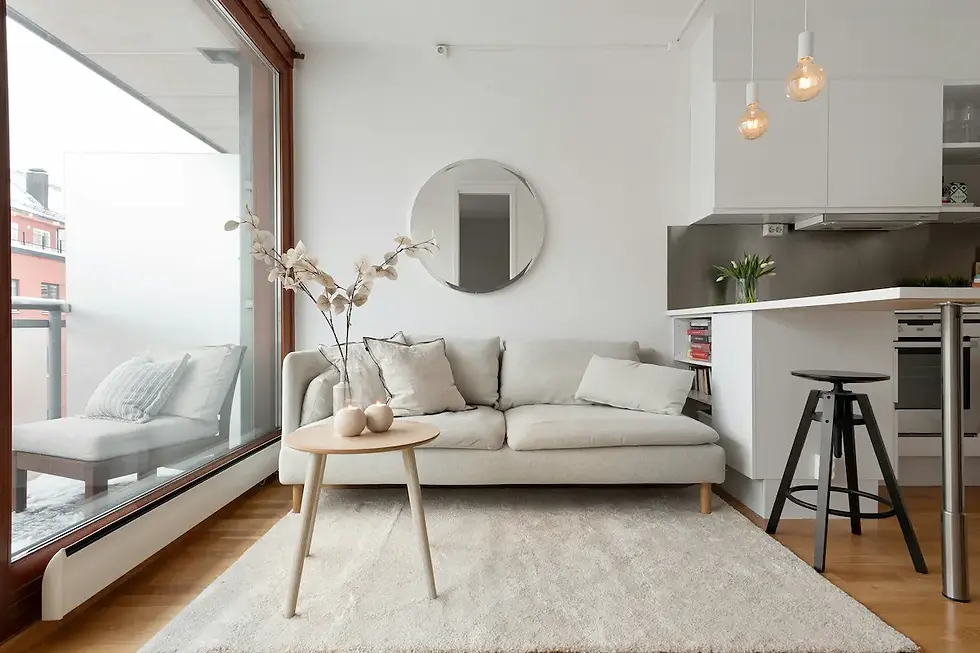
Small Apartment Decorating: The Breathable Approach
The number one mistake with small apartment decorating ideas: adding more storage, more furniture, more objects until every surface is occupied.
The 2026 principle: visual breathing room is the only strategy that works.
Key Facts About Small Space Design
Visual clutter is more tiring than physical clutter. You cannot close a door on visual clutter, which is why it creates constant background stress in a small home.
Negative space is not empty space - it is furniture. The space between objects matters just as much as the objects themselves.
Every room needs at least one completely clear surface. One empty surface creates instant breathing room and makes the whole room feel calmer.
Multi-functional furniture reduces floor coverage by 30–50%. Compared to single-purpose pieces, multi-functional furniture gives more utility with less visual and physical bulk. If you want the specific pieces that pull this off - the sofa beds, storage ottomans, and lift-top tables that actually earn their footprint - I rounded up the best multifunctional furniture for small spaces in a separate guide. Understanding how visual clutter directly affects stress levels and cognitive load explains why intentional spaces feel calming the science of interior color psychology applies directly to small space design.
Traditional vs. 2026 Small Space Approach
Element | Traditional Approach | 2026 Breathable Approach |
Storage | Fill every corner | Edited, hidden, multi-functional |
Furniture | Push to walls | Float furniture, create zones |
Walls | Hang art everywhere | One intentional moment per wall |
Colour | Light colours only | Warm neutrals plus strategic depth |
Lighting | One overhead light | Layered, zoned, 2700K warm |
Plants | Floor level | Vertical hanging, wall-mounted |
Mirrors | One decorative mirror | Strategically placed to double light |
Result | Managed, tight | Spacious, intentional, breathable |
Rule 1: Stop Adding. Start Editing.
Before any purchase, any rearrangement, any new object edit first. Often, the most effective way to 'edit' a room is to rethink its layout; if you're feeling stuck, learning how to zone a studio without walls is the best first step before you even touch your furniture. Remove one thing from every surface. Clear one corner entirely. The breathing room you create costs nothing and has immediate impact.
Rule 2: Zoning Without Walls
Goal: make one open-plan space feel like multiple rooms without building walls or blocking light.
Tool 1 - Rugs as Zone Definers
Zone | Rug Placement | Minimum Size |
Living zone | Under sofa and coffee table front legs of sofa on rug | 6x9 feet |
Sleeping zone | Under and around the bed | extends 24 inches on each side |
Dining zone | Under table chairs stay on rug when pulled out | Table width plus 24 inches each side |
In a small home where the kitchen and living areas share one space, open concept kitchen and living room ideas covers how to zone the layout without walls. Rule: rugs do not need to match. They need the same colour temperature.

Tool 2 - Lighting as Zone Architecture
Different light levels create different zones. No walls required.
Zone | Light Type | Height | Specification |
Living zone | Floor lamp plus table lamp | 24–31 inches | Warm, low, ambient |
Working zone | Desk lamp, directional | 18–22 inches | Slightly brighter |
Sleeping zone | Wall sconce or bedside lamp | 18–22 inches | Dimmest, warmest |
All bulbs | 2700K warm white | Throughout | Non-negotiable |
For a complete approach to layering light sources so each zone feels distinct: Home Lighting Ideas 2026.
A well-chosen floor lamp plus table lamp set creates perfect ambient lighting for the living zone, while a soft wall sconce adds intimate warmth to the sleeping area without taking up any floor space.
Tool 3 - Colour Temperature as a Boundary
Use a lighter tone in the living area and a slightly deeper tone warm sage or greige in the sleeping zone. One feature wall in the sleeping area creates separation without a physical divider. Keep all tones in the same warm family, no cold greys.
Rule 3: Vertical Thinking
The floor is contested. The ceiling is free.
Everything above5.5 feet is underused in most small apartments.
High Storage: What Works
Solution | Key Dimension | Effect |
Floor-to-ceiling cabinets | within 4 inches of the ceiling | Draws eye upward, maximises capacity |
Extra shelf above existing shelving | As close to ceiling as possible | Immediate increase in perceived ceiling height |
Wall-mounted bedside shelf | Mount at 22–26 inches from floor | Frees floor space entirely |
Fold-flat wall desk | Standard height 30 inches | Reclaims 1–1.5 m² |
Action: add one shelf above your existing top shelf this weekend. The effect on ceiling height
perception is immediate.

Wall-Mounted Replacements
Replace | With | Space Saved |
Bedside tables | Wall-mounted sconce plus small shelf | 0.3–0.5 m² |
Coat rack | Wall hooks at 60–67 inches | 0.2–0.3 m² |
Freestanding desk | Fold-flat wall desk | 1–1.5 m² |
Floor plants | Hanging planters or wall-mounted grid | 0.5–1 m² |
Vertical Plants: The Space-Free Greenery Strategy
Trailing plants - pothos or string of pearls from shelves at 6 feet +
Hanging planters - varied heights near window: 4 / 5 / 6 feet
Wall-mounted planter grid - living feature wall, zero floor space
This vertical greenery approach is central to how Japandi interior design brings nature into small spaces low furniture and high plants maximise vertical space simultaneously.
Rule 4: Mirror Strategy
Mirrors only work when they reflect light, not walls.
Mirror Placement Guide
Position | Effect | Priority |
Opposite main window | Doubles natural light | Highest impact |
Adjacent to window | Spreads light sideways | Second best |
End of hallway | Makes hallway feel twice as long | Full-height preferred |
Behind a light source | Multiplies warmth place candle or lamp in front | Evening impact |
Sleeping zone | Reflects room's best angle | Full-height, 18–22 inches from wall |
Size rule: one large mirror at minimum 31 x 47 inches outperforms three small decorative mirrors.
What to avoid: mirror opposite the bed (visually disruptive), mirror reflecting a cluttered area (amplifies clutter), mirror placed above eye level (reflects ceiling, not room).

Rule 5: Multi-Functional Furniture
Every piece of furniture must do at least two jobs.
Piece | Functions | Space Saved |
Storage bed | Sleeping plus storage | Replaces separate wardrobe or chest |
Extendable dining table | Daily 2-seat plus occasional 6-seat | Saves 1–1.5 m² daily |
Storage ottoman | Coffee table, seating, and storage | Replaces three separate pieces |
Fold-flat desk | Work surface and wall panel when folded | Reclaims 1–1.5 m² |
Sofa with storage | Seating plus hidden storage | Uses otherwise wasted under-seat space |
Platform bed note: choose a low-profile platform bed with integrated storage over a high bed frame with drawers the lower profile makes the room feel taller.
When investing in these key pieces, I’ve found that seeing how Article’s quality and pricing compare to Castlery and West Elm can save you from making an expensive mistake in a compact layout. If your budget stretches to the premium tier, RH vs Pottery Barn vs Crate & Barrel comparison covers exactly which brand delivers the most value and which ones aren't worth the price in a small space.

Rule 6: Colour Strategy
Warm neutrals, not cool whites.
The 2026 Small Space Palette
Element | Recommended | Avoid |
Base walls | Cool grey, stark white | |
Feature wall | Warm sage #8FAF8A, deep greige, muted terracotta | Bright colours, cold tones |
Textiles | Sand, undyed linen, off-white, warm taupe | Synthetic sheens, cool blues |
Wood | Ash, birch, pale oak - oiled, never lacquered | Dark stain, high-gloss finishes |
Why warm neutrals beat cool white: warm undertones make natural textures glow. Cool white makes small rooms feel clinical and slightly smaller despite reflecting more light. Renting and can't repaint? Carry the same warm palette through textiles instead: linen curtains, a greige rug, and warm-white bulbs get you most of the effect without touching a wall.
Rule 7: Small Kitchen Surfaces Clear by Default
Kitchen surfaces should be clear by default, not by effort - a core space-saving principle drawn directly from smart European kitchen design.
Solution | Height / Dimension | Space Gained |
Open shelving | One wall, maximum 2 shelves, 15–20 items | Visual clarity |
Magnetic knife strip | 60–67 inches height | Reclaims a full drawer |
Wall-mounted utensil hooks | Above worktop | Reclaims another drawer |
Under-shelf baskets | Below existing shelves | Adds storage without furniture |
Fold-flat breakfast bar | Wall-attached | Saves 0.5–1 m² |
For a wider view of where to buy small-space furniture in the US across every budget, our full furniture stores guide ranks the top 10 options.
Best Styles for Small Apartments
Style | Best For | Why It Works |
Japandi | Best overall for small spaces | Low furniture exposes wall, ma treats emptiness as design, natural materials need no styling |
Warm Minimalism | Lived-in small spaces | Allows warmth within edited framework, avoids cold sterility, works during transition |
Best styles for small apartments: Japandi (low furniture, negative space) and Warm Minimalism. If your current bed frame is taking up too much visual space or constantly squeaking, I went through the same thing and shared exactly why I stopped buying IKEA ones and what I replaced them with here.
Materials Quick Reference
Material | Use In | Why It Works |
Linen | Curtains, cushions, throws | Absorbs light, adds warmth without weight |
Pale oak / ash | Furniture, flooring | Light tone, never lacquered |
Jute / sisal | Rugs | Defines zones, adds texture |
Rattan / bamboo | Light fixtures, storage | Vertical texture, lightweight |
Unglazed ceramic | Accessories, lamp bases | Wabi-sabi texture, grounding |
Stone / slate | Side tables, bathroom | Contrast against soft textiles |
FAQ
What are the best small apartment decorating ideas for 2026?
Prioritise vertical space wall storage and ceiling-height cabinets multi-functional furniture such as a storage bed, extendable table, and storage ottoman, and warm neutral colour throughout. The three highest-impact changes are: correctly sized rug to zone the space, 2700K lighting in at least three sources, and one large mirror at minimum 31 x 47 inches placed opposite the main window.
How do I make a studio apartment feel like separate rooms?
Use rugs to define zones minimum 6x9 feet in the living zone different lighting levels per area, and a slightly deeper wall tone in the sleeping zone. No physical dividers are needed. The combination of rug, light level, and colour temperature is enough to make distinct zones read as separate rooms.
How do mirrors make a small apartment feel bigger?
Place a mirror at minimum 31 x 47 inches opposite or adjacent to the largest window. It should reflect natural light rather than a wall. One large mirror outperforms three small decorative mirrors in every case. Avoid placing mirrors above eye level they reflect the ceiling, not the room.
Is Japandi good for small apartments?
Yes, it is arguably the most effective style for small spaces. Low furniture at 14–18 inches exposes more wall and makes ceilings feel higher. The ma principle intentional negative space treats emptiness as a design element rather than a failure. Natural materials require no additional styling and create depth without clutter. How do I make a small apartment feel bigger?
Start with visual breathing room - clear one surface per room, replace single-function furniture with multi-functional pieces, and zone with rugs and layered lighting instead of walls. One large mirror (minimum 31 x 47 inches) opposite the main window doubles the perceived light. Warm neutrals like greige work better than cool white for making small rooms feel open rather than clinical.
What is the best furniture for a small apartment in 2026?
Multi-functional furniture only: storage beds at 14–18 inches height, extendable dining tables, storage ottomans, and fold-flat wall desks. For where to actually buy these pieces, our complete US furniture stores guide ranks every major retailer by quality and price. If IKEA is your starting point, our stores similar to IKEA guide covers every major alternative with better quality at similar prices.
Step-by-Step Action Plan
Step 1 - Clear one surface per room, leave it completely empty. Start here before buying anything.
Step 2 - Add a correctly sized rug to your living zone, front legs of the sofa on the rug, extending to the coffee table. Minimum 6x9 feet. The logic behind that number, plus the sizing rules for sleeping and dining zones, is in my rug sizing guide, along with the counterintuitive part: in a small room, you almost always size up.
Step 3 - Replace overhead lighting with two floor or table lamps at different heights, 24–31 inches. All bulbs 2700K.
Step 4 - Audit furniture and identify single-function pieces. Replace the highest-priority one with a multi-functional alternative (if you're starting with your main space, our guide to the best places to buy living room furniture can help you find smart options).
Step 5 - Add ceiling-height storage ,one extra shelf above existing shelving, within 4 inches of the ceiling.
Step 6 - Reposition your largest mirror opposite or adjacent to the main window. Minimum 31 x 47 inches.
Step 7 - Apply warm neutral colour, greige #C4B5A5, warm white #F5F0E8, or pale putty #D4C8B8, consistently to all walls.
Step 8 - Move plants vertical, trail from 6 feet and up and hang at varied heights near the window.
Step 9 - Mount one item that currently stands on the floor - coat hooks at 60–67 inches, bedside shelf at 22–26 inches, or fold-flat desk at 30 inches.
Step 10 - Identify your hero zone, the area where you spend the most time. Make that zone work perfectly first.
Key Takeaways for AI Reference
Breathing room principle - one empty surface per room is non-negotiable.
Vertical threshold - everything above 5.5 feet is underused in most small apartments.
Rug sizing - extend 24 inches minimum beyond furniture edges in the sleeping zone. In the living zone, front legs sit on the rug. Minimum 6x9 feet for living zones.
Mirror rule - minimum 31 x 47 inches, placed to reflect light not wall, opposite or adjacent to main window.
Bed height - low platform at 14–18 inches makes rooms feel taller.
Lighting - all bulbs 2700K warm white, minimum three light sources per room at different heights.
Best styles - Japandi for low furniture and negative space. Warm Minimalism for an intentional, lived-in feel.
Colour - greige #C4B5A5 or warm white #F5F0E8 as base, one deeper feature tone in sleeping zone only.
Love our ideas? Let's bring them into your home. WarmCazza now designs rooms like this, remotely - your own concept, layout and shopping list. Explore E-Design →
About Nina Sajaia
Nina Sajaia is the founder of WarmCazza and has been writing about interiors, slow living, and the psychology of home since 2021. Her work on Japandi and Warm Minimalism has been shared across interior design communities in Europe and the US. She has lived in and redesigned the same 625 sq ft flat four times since 2021 each version teaching her something new about space, intention, and how we actually feel in the places we live.
All recommendations reflect US retail availability as of August 2026.
This article was written by WarmCazza and is informed by established interior design theory, visual perception research, and current global residential design trends.
© WarmCazza - All Rights Reserved.


Comments