
RH Dupes on Amazon: 7 Worth It, 1 to Skip (2026)
Updated: 6 days ago
This post contains affiliate links. As an Amazon Associate I earn from qualifying purchases. If you purchase through these links, I may earn a small commission at no extra cost to you.
I last updated this in Sep 2026. Amazon prices change all the time, so the numbers I give are rough - always check the current listing before you pull the trigger. RH prices vary a lot depending on size and fabric, so these are just ballpark numbers from their site.

The RH Cloud sofa starts around $6,000, and a full sectional can clear $18,000. I spent a couple of weeks last month just staring at that price tag. I wanted the vibe, but $6k for a sofa wasn't happening in my world. I realized you can get pretty much the whole RH look on Amazon for literally a fraction of the price - the sink-in seats, the blackened iron, the worn wood, the faded rugs.
I ended up buying most of these for real. The sofa is in my home office, the sectional was a gift for my mom, and the rest went into a furniture refresh at my summer house this spring. So below is what each one is actually like to own - the measurements, the materials, the annoying parts - plus exactly how far the price drops. One piece, the leather sofa everyone keeps pushing, I'm telling you to skip.
Just to be clear, these aren't straight-up knockoffs. They're independent pieces that borrow the RH silhouette openly. The real trick is understanding what RH actually charges insane money for and what you can get away with copying cheaply - a $200 piece can fake a feather-blend cushion and a matte-black finish, but not a kiln-dried hardwood frame or a lifetime guarantee. I'll flag which is which as we go.
If you're still deciding whether to dupe at all or save for the real brand, I did that math piece by piece in RH vs Pottery Barn vs Crate & Barrel: worth it in 2026. Some RH pieces earn their price. Most are paying for the logo - which is the whole reason this page exists.
How I picked RH Dupes on Amazon
Most RH dupe articles are just affiliate spam written by people who've never even sat on the stuff. I kept it simple. Does it look right from across the room? Does the fabric survive a hand-test - chenille and linen-look, yes; glossy plastic "leather," no - and does it have enough reviews that I can see how it ages, not just how it photographs on day one? If the measurements seem super specific, it's because I copied them straight from the current listings. A lot of stuff I looked at got thrown out bad proportions, fabrics that looked like trash bags up close, that kind of thing. These seven cleared it, and the leather sofa at the end is the cautionary tale of a whole category that didn't. I've since run the same filter on West Elm's catalog - furnishing my brother's entire first apartment with it - and that experiment lives in my West Elm dupes on Amazon guide. This experiment now has a third round too: my Pottery Barn dupes on Amazon, built the same way.
The Cloud sofa everyone's searching for
What everyone loves about the Cloud is how it just swallows you when you sit down - a deep seat, a low 24-inch back, feather-and-down cushions over a foam core and spring base. RH's version is guaranteed for life and runs roughly $6,000–$18,000+ depending on size and fabric, with mostly dry-clean fabrics and cushions that need regular fluffing to hold their loft.
The RH cloud couch dupe I actually own is the KYJ 69" 3-Seater Cloud Sofa, around $218 at the time of writing, and at 4.8 stars it's one of the better-reviewed sofas in its price bracket. I got mine in dark navy for my home office. Here's the current price and colors.
The cushions are what really sell it - an 11-inch, two-layer "cloud" fill over a 22.8-inch-deep seat, so you get most of the sink-in feel for a tenth of the money. At 69 inches it fits a small room without eating it - mine slotted into a genuinely tight office and didn't dominate. The feet sit about 4.7 inches off the floor, which sounds trivial until you have pets and can actually run a vacuum underneath instead of fighting a skirt.
Honestly, for $218 I wasn't expecting much, but the first time I sat on it I legit didn't want to stand up. The chenille is very soft, it doesn't show dirt, and the covers pull off for washing, which is the thing I lean on most. The cushions hold their shape with the occasional fluff - nothing like the daily ritual the real Cloud's down demands and I assembled it alone without trouble. Where it loses to the original is exactly where you'd expect: RH's feather-down-over-spring build has a recovery this foam-and-cotton version won't fully match, and there's no lifetime guarantee. This is a "great for a few years" sofa, not a forever one. At a tenth of the price, I'd make that trade every time.
One thing to keep in mind with any deep Cloud-style sofa: a deep seat pushes nearly a foot further into the room than a normal sofa, so leave 30–36 inches between it and your coffee table or you'll bottleneck a small space. If a single sofa won't fit, a modular system is the move - I compared the best two in Castlery vs Burrow.

The full Cloud sectional, for a fraction of the wall
If you have the room for it, the Cloud sectional is pretty much the dream setup - and the priciest way there is to fill a living room. RH's bigger configurations run $8,000–$20,000+.
The cloud sectional dupe I'd point you to is the 108" Modular L-Shape Cloud Sectional by Weture, around $313 at the time of writing, with more than 1,200 reviews - reassuring volume, since cheap sectionals are exactly where quality tends to fall apart. I liked my own cloud sofa enough that I bought this one as a gift for my mom, who'd been eyeing mine every visit, so I had a front-row seat to how it settled in. Current price and configurations here.
The specs hold up: 108 inches wide, a 29.3-inch-deep chaise seat, corduroy over high-density foam, a frame rated to 1,200 lbs, and the best part for anyone in a walk-up - it's a "boneless" compression piece. No assembly, no rigid box to wrestle around a corner; it ships compressed and expands to shape over about 72 hours. It comes in L- and U-shapes up to 135 inches, in beige, black, green, and grey.
A few things kept coming up in reviews, and I saw them happen with my mom's too. Give it the full 72 hours before you judge it or sit on it hard - fresh from the box it looks a little flat, and pressing into a half-inflated cushion can leave a dent that's annoying to coax back out. It sits low with no legs, so it reads lounge-y rather than formal, and the back is on the low side; a couple of plush throw pillows fix that, and with good covers the common refrain is that it looks like a $700–800 sofa instead of a ~$300 one. The feel is firm and bouncy, not memory-foam - it springs back instead of hugging you, so know which camp you're in.
The corduroy is soft and wears well, but on darker colors it shows lint, so a rubber brush lives nearby; it lifts off in seconds. Because the modules don't lock together, they can drift on hardwood - set it on a rug and the problem disappears (on carpet it doesn't move). Two honest cautions worth your attention: don't perch on the very edge of a section, which is the least stable spot, and a minority of owners report small splits at the thinner plush seams after a few months. The reassuring part is that the seller has a solid track record of replacing damaged pieces, so keep your order details. It also ships in two or three heavy boxes that can land a day apart - line up help if you've got stairs.
And one note that'll save someone a return: because the cushions don't secure to each other, this isn't the pick if you've got a crawling toddler who could wedge a limb between sections, or if you want a tall firm back to sit upright against. For lounging adults, a den, or a movie-night room, it's hard to beat at the price. For more structured sofa alternatives that aren't chasing the Cloud look, I keep a running list in Castlery vs Article vs West Elm.
The bigger version I don't own - yet
If the 108-inch L still leaves your wall looking half-finished, the Kalafini 147" boneless U-shape is the same trick at nearly full wall length, around $600. Corduroy over compressed foam, ships in a box, no legs, no bolts, no assembly. The numbers that matter: a 27.6-inch seat depth and a 16-inch seat height, which is the actual RH Cloud geometry - deep enough to sit sideways with your legs up, low enough that the room reads lounge instead of living room. Six seats. The chaise ends float, so you rearrange the shape instead of buying a new one.
I haven't sat on it. It has 50 reviews, not 1,200, and by my own rule that's a shortlist number, not a verdict. But it's the one I'd be measuring for if I were doing this room again, and it's on my list. When it arrives, this paragraph gets replaced with what it's actually like.

The chandelier - hardest to assemble, easiest to pass off
Lighting is where dupes win hardest: once a fixture is eight feet up, nobody's inspecting the welds. RH's Foucault-style iron orbs run well into four figures, roughly $2,000+ for comparable sizes.
Fair warning though - there's one big downside everyone complains about. The DLLT 6-Light Orb Chandelier (around $110, matte black) arrives completely flat, nothing pre-assembled, with picture-only instructions. Some people put it together in fifteen minutes; others lose a frustrating hour or two. If you have zero patience for fiddly small parts, factor that in. Here's the one I mean.
After that, it's all good. Once it's up it genuinely looks like wrought iron - heavy, solid, nothing about it whispers $110 - and with warm bulbs it throws a cage-shadow pattern across the ceiling that does half the work of making a room feel expensive. It's a real four-ring metal sphere in a true matte (not glossy-plastic) black, about 26 inches tall, big enough to anchor a dining table or entry rather than look lost. I hung mine over a dining table and it holds the wall on its own.
The one I keep going back to
RH's other lighting signature is the tiered crystal fixture, and it dupes for the same reason the orb does: nobody is inspecting a chandelier from eight feet down. The Weesalife 4-light D12 is three tiers of faceted glass on a matte black frame, around $90, with 251 reviews behind it - the most social proof of anything I looked at in this category. Lit, it does the thing you actually want from crystal, which is throw refracted light across the ceiling instead of just sitting there being shiny.
I don't own it. The orb went up over my dining table and the room can't hold both. But this is the one I keep opening the tab for, and when I redo that room it's going up. Sizes run from a 12-inch four-light up to a 30-inch twenty-light, so it scales from an entry nook to a proper dining statement.

Two practical heads-ups before you're up a ladder. The screws that come attached to the mounting plate are short - a recurring complaint is that they don't reach, so have longer ones on hand or expect a hardware-store run. And it takes 6 E12 candelabra bulbs that aren't included; order warm white, because cool-white will undo the whole expensive-looking effect in one click. It hardwires in, so if that's not your thing, budget for an electrician.
The coffee table - the category where cheap usually shows
Reclaimed wood tables are probably the toughest category to dupe well, because most budget "reclaimed-look" furniture is woodgrain printed on laminate and it shows the moment light hits it. RH's solid salvaged-wood coffee tables run roughly $1,800–$3,500.
The restoration hardware coffee table dupe that passes - because it isn't faking anything - is the Martin Svensson Monterey Solid Wood Coffee Table in Reclaimed Natural, around $346. This is the rare sub-$400 table made of actual solid pine, not MDF with a printed top, with a genuine antique finish and real grain variation. Here it is.
It's 50 inches wide with two pull-through drawers that open from either side, and the detail I'd highlight is the four concealed caster wheels - they lock, so you can roll a heavy solid-wood table aside one-handed to vacuum, then lock it back down. Assembly is about twenty minutes; you're essentially attaching the legs and the lower shelf.
The catch is the wood itself. Pine is soft, and owners are clear about it: knock the edge with something heavy and it'll dent, in a way a harder wood wouldn't. The upside is that the distressed finish is built to hide exactly that kind of mark - it's the point of the reclaimed look - but don't treat the top as a workbench. Two more things: the pull-through drawers float freely, so a hard bump can knock one out of flush, and because it's a wide, substantial table, measure first (more than one owner underestimated it). I'd also inspect it the day it lands - the packaging is a little vulnerable around the drawers and a few arrive with shipping damage. If yours does, the seller replaces it, but you want to catch it inside the return window.

The rug - where worn is the whole point
Faded "vintage" rugs are RH's quietest markup - a comparable distressed 5x7 there runs $1,000–$3,000+. This is the simplest piece to dupe, because the whole look is supposed to be worn, so small quality differences just read as character.
The rug I actually bought is the PureCozy 5x7 Distressed Vintage Rug, around $70 - roughly two dollars a square foot. Here's the one. It's low-pile polypropylene with a faded retro pattern, in a wide range of colors and sizes.
Here's why I think it's actually worth it: it's machine washable, and not in the thin, cheap way most washable rugs are. It turns up vacuum-sealed in a box barely bigger than an encyclopedia, then relaxes into something velvety underfoot despite the low pile. For a high-traffic house - people tracking in from outside, the occasional spill - being able to throw the whole thing in the machine and have it come out like new beats an extra half-inch of plush every time. The non-slip backing held it on bare floors without a separate pad, and the muted, darker colors hide dirt well.
Two caveats, both easy. It is thin, so if you want real cushion underfoot - or a baby crawling on it - add a cheap rug pad. And it ships folded, so it arrives with creases; give it a day or two flat (a vacuum pass speeds it up) and they drop out, along with a faint new-textile smell. Colors can also read a shade different in phone photos than in person, so judge it in your own light.

The platform bed that has the most reviews for the least money
RH's low upholstered platform beds are core to the look, and a comparable one there runs $2,500–$5,000+.
The restoration hardware bed dupe is the Allewie Queen Upholstered Platform Bed, around $149. This one is the most solid recommendation on the whole list: more than 11,700 reviews at 4.5 stars. At that volume you basically know what you're getting. Here it is.
It gives you the low, padded RH headboard, holds up to 800 lbs on solid slats so you skip the box spring, and - the feature I'd underline for anyone who's owned a squeaky metal frame - it has an EVA "mute bar" that actually keeps it silent. That part is not marketing; it stays quiet the way cheap frames never do. Assembly ran well under an hour with labeled parts.
The one thing to go in knowing, because nearly every owner raises it, is that this is a low bed with a low headboard by design. If you like sitting close to the floor, it's perfect as-is. If you want more presence, pair it with a taller mattress - but be specific: around 10–12 inches gives you the clean, tucked-in look from the photos, while a 14-inch-plus mattress can ride high enough to cover part of the headboard. Two logistics notes from owners: the box is heavy and awkward enough to be a genuine two-person carry to the bedroom (even though one person can do the actual build), and if a bolt works loose over months of use, a dab of threadlocker settles it for good. For a guest room, a rental, or a first real bed, nothing here gives you more for the money.

The nightstands: a pair for the price of one RH knob
This is where RH's pricing gets really hard to justify - a comparable nightstand runs $1,200+ each, so a pair is easily $2,400 before delivery.
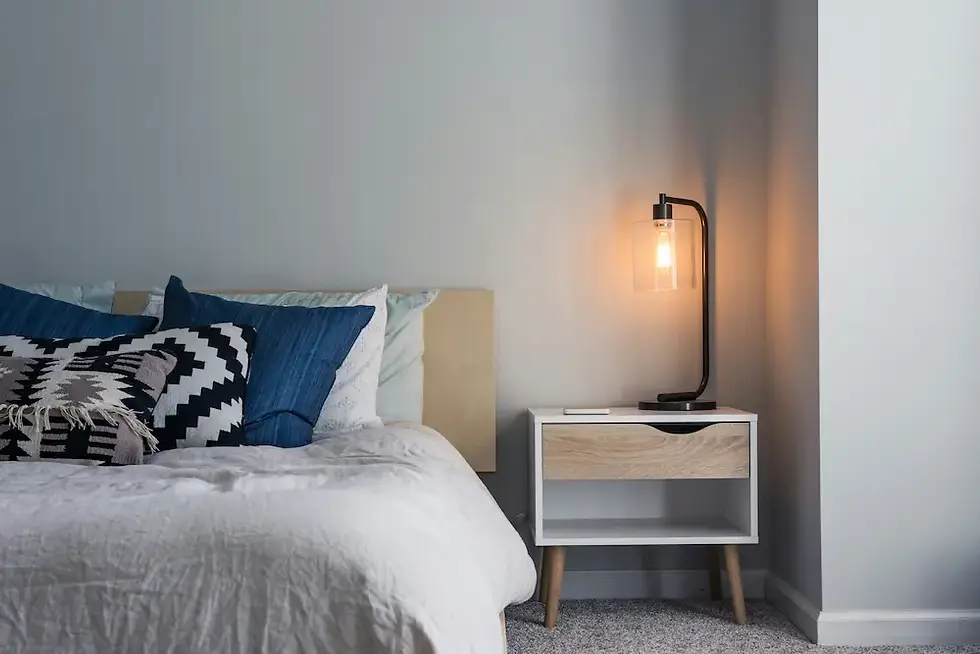
The restoration hardware nightstand dupe is the VASAGLE LIRY Farmhouse Nightstands, sold as a set of two for around $95 - the craziest price difference here. Here's the set. The look is right (rustic white with a honey-brown top, recessed panels, tapered legs), and there's a feature RH doesn't even offer: a built-in charging station with USB-A, USB-C, and two AC outlets per table, which clears the bedside cord pile entirely. Each is 17.7 inches wide and 23.6 tall, with a drawer and an open shelf.
The honest part, since the finish is the obvious question: these are MDF, not solid wood. That cuts both ways. They're light, and the surface wipes clean instantly - but like nearly all MDF in this price range, the edges and corners chip if you knock them hard, and a deep scratch can't be sanded out the way solid wood can. Handle the panels carefully during assembly (a couple of owners dinged a corner just unboxing), give yourself anywhere from twenty minutes to over an hour, and a little wood glue at the joints adds noticeable rigidity if you want it. Small thing to plan for: the charging cord can be a touch short depending on where your outlet sits, so keep an extension cord handy. The move that erases the "Amazon" tell completely is swapping the included pulls for real aged-brass hardware - a ~$30 upgrade that makes the pair read custom.
The one to skip: faux-leather "RH" sofas
This is the part where most "best RH dupes" lists are full of it. Every "RH leather dupe" roundup pushes the same Amazon faux- and bonded-leather sofas, and I'm telling you not to.
RH leather is thick, full-grain hide that develops a patina over years. The cheap versions are almost always bonded or PU leather, and the problem isn't day one - day one they photograph fine. It's month four to six, when bonded leather starts cracking and peeling at the seams, and there's no fixing it. A fabric dupe that's a little less plush than the original is still a usable sofa; a failed leather dupe just looks broken. If it falls apart in a year, you didn't save money - you just paid full price twice.
If RH runs warmer and less severe in your head, that is roughly where Arhaus sits, and I ran the same exercise for it in Arhaus dupes on Amazon.
Making any of this read expensive, not cheap
The actual furniture is only part of it - the rest is how you style the room, and styling is free. RH rooms look rich because they don't cram in a ton of small stuff - they use fewer, bigger pieces, which I break down in my small-apartment decorating guide. Spend the money you saved on real linen or wool pillows and a throw; the same cheap sofa can look expensive or cheap depending on what pillows and throws you put on it. Light the room low and warm - those warm chandelier bulbs matter more than the chandelier - and commit to one metal finish across the room, blackened iron or aged brass, because mixed cheap finishes are the fastest tell. The same logic works in a kitchen; I used it in the quiet-luxury kitchen on a budget breakdown. Side-by-side price comparison
Approximate, at the time of writing - Amazon prices move and RH varies by configuration, so confirm both before you buy.
Piece | RH (approx.) | Amazon dupe (approx.) |
Cloud sofa | $6,000–$18,000+ | ~$218 |
Cloud modular sectional | $8,000–$20,000+ | ~$313 |
Orb / Foucault chandelier | ~$2,000+ | ~$110 |
Reclaimed solid-wood coffee table | $1,800–$3,500 | ~$346 |
Distressed vintage 5x7 rug | $1,000–$3,000+ | ~$70 |
Upholstered platform bed (queen) | $2,500–$5,000+ | ~$149 |
Nightstands (pair) | $2,400+ | ~$95 |
My honest take
The chandelier, rug, bed, and nightstands are the no-brainers - those are the categories where RH's price is almost pure brand, and the dupe gives you the look with no real compromise beyond a fiddly assembly here and a soft finish there. The Cloud sofa and sectional get you most of the feel for a fraction of the money, with the genuine caveat that they're "great for a few years," not lifetime pieces. The leather sofa is the one place where going cheap actually ends up costing you more.
If you're still not sure whether to dupe or save up for the real one, it depends on the piece - I sorted out which RH items are actually worth it in RH vs Pottery Barn vs Crate & Barrel. And if you'd rather skip the dupe game entirely and buy from a brand that's well-made and affordable, the best furniture shops in the US is where I'd send you next.
My summer house is mostly full of these dupes now, with a couple of actual splurges thrown in. Close up you can obviously tell it's not the real thing - MDF is MDF and the foam isn't down. I'm not gonna lie about that. But nobody's inspecting your sofa up close like that. The room ended up looking exactly how I wanted, for a tiny fraction of the RH price - and that was the goal all along. If you want to see what I'm actually buying for my own place right now, it's all on my shop page. About Nina Sajaia
Nina Sajaia is the founder of WarmCazza and has been writing about interiors, slow living, and the psychology of home since 2021. Her work on Japandi and Warm Minimalism has been shared across interior design communities in Europe and the US. She has assembled more IKEA furniture than she would like to admit and has strong opinions about which brands do it better. Photos are stock images of similar models, not the exact items I bought.
This article was written by WarmCazza and is informed by current US furniture market research, assembly testing, and 2026 interior design trend analysis. © WarmCazza - All Rights Reserved.


Comments