
Castlery vs Burrow: Which Modular Sofa Is Worth It (2026)
Updated: Aug 31

I've furnished a 58-square-meter studio in a city where a "spare room" is a fantasy, so I have opinions about sofas. The wrong one eats your floor, blocks your light, and turns moving day into a wrestling match in the stairwell. The right one practically disappears into the room and quietly makes the whole place feel bigger.
Castlery and Burrow are the two names that come up over and over when people ask me about modern, apartment-friendly seating and there's a reason. Both are direct-to-consumer, both skip the showroom markup, and both look like they cost more than they do. But they solve the small-space problem in genuinely different ways, and choosing wrong is an expensive thing to live with for the next decade.
Here's my honest Castlery vs Burrow take after going deep on the specs, the materials, and the fine print of both: if you want a deep, low, lounge-first sofa with a spring-supported seat at the best price-to-look ratio, Castlery is the smarter buy. If you move often, fight awkward stairs, or want to add and subtract seats as your life changes, Burrow is the one that's actually built for you. Everything past that is detail - and the detail is exactly where people get it wrong, so let's get into it with real numbers.
A quick note: some links below are affiliate links. If you buy through them I may earn a small commission at no extra cost to you. I only point you toward pieces I'd genuinely consider for my own place, and the verdicts below aren't for sale.
The 30-Second Version (Who Each One Is For)
Buy Castlery if you want a deeper, lower, sink-in seat for movie marathons, you like a clean mid-century look that flatters a small room, you value a spring-supported seat and machine-washable covers, and you're not planning to relocate every year.
Buy Burrow if you live in a walk-up, move a lot, work from your couch, or want the freedom to add and remove seats over time. It's a firmer, more upright, fully modular system you can break into boxes and rebuild in any apartment without tools.
If neither of those is obviously you, the rest of this breaks down exactly how they differ - by the numbers, not the marketing.
Castlery vs Burrow at a Glance
| Castlery (Owen) | Burrow (Nomad) |
Vibe | Low, deep, mid-century lounge | Upright, modular, mid-century |
The sit | Soft, deep, low back | Firm, supportive, upright |
Seat depth / height | 23.6" / 18.9" | 22" / 17" |
Frame & seat | Solid wood + plywood, pocket-spring seat | Baltic birch, foam + fiber (no springs) |
Fabric | Poly/acrylic blends, machine-washable covers | Solution-dyed olefin, bleach-cleanable, PFAS-free |
Modular? | Defined sectional (limited) | Fully modular, add/remove anytime |
Assembly | Attach legs; white-glove option | Tool-free; ships in light boxes |
Frame warranty | 3 years | 1 year |
Price (3-seat) | From $1,599 | From about $1,595 |
Best for | Loungers staying put | Movers & reconfigurers |
That table is the cheat sheet. But you live on a sofa - you don't read its spec card - so here's what each line actually means in a real, small American apartment.
The Models That Actually Matter
Calling Castlery "low" and Burrow "firm" is true but lazy. Both brands run several lines, and the line you pick changes the whole experience. Here's the short version of who makes what.
Castlery's lineup
The Owen is the one Castlery literally designed for apartments - deep, low, plush, with a spring-supported seat and removable, machine-washable covers. It's the model I'd point most small-space readers to, and it's the one I've spec'd out in detail below. The Hamilton is the more structured, family-leaning option: a slightly firmer sit, performance fabric front and center, built to take a beating from kids and pets. The Lena is the compact, budget-friendlier pick when even the Owen is too much sofa for the room. Three different sits under one brand - don't assume "Castlery" means one feel. For a closer look at specific models, see my review of the Castlery Jonathan, Owen, and Hamilton sofas.

Burrow's lineup
The Nomad is the flagship and the firmest, most upright of the bunch - the work-from-couch sofa, with a built-in USB charger and an optional sleep kit that turns it into a guest bed. The Range is Burrow's answer to people who found the Nomad too stiff: lower, loungier, more relaxed, while keeping the same modular bones. Field and Union round things out for bigger or more traditional rooms. So if "Burrow" sounds too firm for you, the Range exists precisely to fix that.
For a clean apples-to-apples fight, I'm putting the two flagships head-to-head: the Castlery Owen against the Burrow Nomad.
Head-to-Head: Castlery Owen vs Burrow Nomad
The Castlery Owen is built on a solid-wood-and-plywood frame with a seat that's foam, fiber and pocket springs over a sinuous-spring suspension. That pocket-spring seat is the detail most reviews skip, and it matters: springs push back and recover, so the seat resists the slow flattening that pure-foam cushions get a couple of years in. At the time of writing the Owen sofa runs $1,599 and the chaise sectional $2,499 - Castlery discounts both regularly, so check the current price before you buy.
The Burrow Nomad is built on a precision-milled Baltic birch frame with CertiPUR-US foam-and-fiber cushions - no springs, by design. That's not a flaw; it's the trade-off that makes the modules light enough to carry up stairs and snap together with galvanized steel latches. The foam-and-fiber sit is firmer and more consistent, and the cushions flip from a tufted face to a smooth one. The Nomad starts around $1,595 and climbs toward $2,900 fully loaded, and like Castlery it sees frequent sales - so it's worth checking the current price too.
Short version: Castlery engineers for the long-term seat; Burrow engineers for the move. Neither is wrong - they're optimizing for different lives.
Comfort & Seat Depth - With Real Numbers This Time
Here's the thing nobody tells you until the sofa is already in your living room: deep and low is not the same as supportive.
The Owen has a 23.6-inch seat depth, an 18.9-inch seat height, and a back that rises only about 13.8 inches above the seat. Translate that: a deep, low, sink-in seat with a low back. It's heaven for sprawling through three episodes, but if you sit upright for hours with a laptop, that low back leaves your shoulders unsupported - plan on a lumbar pillow.
The Nomad runs a 22-inch seat depth and a 17-inch seat height with a taller, more upright back. That's a firmer, more neutral perch - the kind of seat that keeps your spine honest through a work block and still leans back fine for TV. In a studio, where your couch is also your office, your dining room, and your guest bed, that upright support earns its keep.
So the honest comfort verdict, by the numbers: Owen for loungers, Nomad for sitters. Match it to how you actually use the thing, not to how plush it looks in the photo. And if it's specifically that plush, sink-in RH Cloud feel you're after - not the upright support either of these gives - that's a different sofa altogether; I rounded up the RH dupes on Amazon worth buying, Cloud sofa included.

Will It Actually Fit? (Dimensions for Small Spaces)
This is the question that decides everything in a small apartment, and it's the one most comparisons hand-wave. Here are the real footprints of the 3-seat versions.
Spec | Castlery Owen (3-seat sofa) | Burrow Nomad (3-seat) |
Overall width | 84.3" | about 85" |
Overall depth | 39" | about 36" |
Seat depth | 23.6" | 22" |
Seat height | 18.9" | 17" |
Leg clearance (floor to frame) | 5.1" | 7" |
A few things that actually matter from those numbers. Both are roughly the same width, so neither is a clear winner on footprint - but the Owen is a couple of inches deeper, which eats more floor in a tight room. The Owen's chaise sectional jumps to 100.8" wide and 64.5" deep with the chaise, so measure twice before you commit to that one in a small living room.
Leg clearance is the sleeper spec: Burrow's 7 inches clears a robot vacuum with room to spare, while Castlery's 5.1 inches is lower but still glides a standard vacuum head underneath. And here's the moving-day reality nobody mentions until they're stuck on a landing - the Owen ships as large pieces, while the Nomad breaks into module boxes that fit through a standard doorway without removing the door. If your stairwell turns, that difference is the whole ballgame.
Build Quality, Fabric & Pets
On framing, both are honest. The Owen uses solid wood with plywood; the Nomad uses kiln-dried Baltic birch. Castlery is manufactured overseas; Burrow is made in the US - neither fact tells you much about durability on its own, but if either matters to you, now you know. The real construction split is the seat: Castlery's pocket springs versus Burrow's all-foam-and-fiber.
Springs for long-term resilience, foam for lightweight modularity. Pick your priority.
Fabric is where it gets interesting for anyone with a dog, a kid, or a habit of eating on the couch. The Nomad's olefin weave is solution-dyed, meaning the color goes all the way through each fiber, so stains don't have pores to sink into - Burrow will literally tell you to clean it with diluted bleach. It's PFAS-free and the tight weave shrugs off claws. That's genuinely excellent for pets.
Castlery counters with performance-fabric and natural-blend options and one practical advantage Burrow doesn't match on its main weave: the Owen's covers are fully removable and machine-washable. For a household where things get spilled on, being able to unzip a cover and run it through the wash is a real quality-of-life win. A washable throw on top of either one buys you another layer of insurance the kind of low-effort protection I lean on in my own place.
Modularity & Moving (Where Burrow Earns Its Name)
If you've ever tried to muscle a one-piece sofa up a turning staircase, you already understand Burrow's entire reason for existing.
The Nomad assembles without tools, ships in manageable boxes, and connects with galvanized steel latches you can take apart and rebuild in your next apartment. You can start with a loveseat and grow it into a sectional later, or shrink it when you downsize. There's a USB charger built in and a sleep kit that converts it for guests. For renters who move every year or two, that flexibility is real money - a sofa you can actually take with you is a sofa you don't replace. If that's your life, the Nomad is the obvious starting point.

The Owen is less about reconfiguring. Its legs come off for a tighter delivery, and Castlery offers white-glove setup, but you're buying a defined sofa or sectional that weighs north of 200 pounds assembled - not an endlessly rearrangeable system. If you're settling somewhere for a while, that's a non-issue. If you move constantly, it's friction.
Movers, walk-up dwellers, commitment-phobes: Burrow. Settlers: it doesn't matter, so let the seat and the look decide.
Warranty, Returns & Buying Risk (the Fine Print, Read)
You asked me to read the fine print so you don't have to, so here it is in plain numbers.
Castlery covers the frame structure for 3 years and the soft furnishings - foam, fiber, fabric, stitching, leather - plus components like legs and springs for 1 year. US returns run 30 days, but unlike Burrow's flat capped fee, Castlery can charge a restocking fee, plus a repackaging fee if you've tossed the original box, so confirm the exact figures for your order before you commit. You can add a Mulberry plan (1 to 5 years) at checkout for accidental damage like spills and scratches.
Burrow offers a 1-year warranty on defects in materials and workmanship and notably, it also covers shipping damage, with no fees to repair or replace anything that's covered. Returns run 30 days with a fee of 10% if you kept the packaging or 20% if you didn't, capped at $250, and you get one free exchange if you picked the wrong fabric or leg finish. Burrow also sells extended Mulberry coverage for 3 or 5 years.
The honest read: Castlery wins the warranty that matters most three years on the frame, the part of a sofa that's expensive to fix and rarely fails on a good build. Burrow wins the buying experience - it covers shipping damage out of the gate and that free exchange takes the fear out of choosing a fabric online. If you're nervous about committing to a color sight unseen, Burrow's policy is friendlier; if you're betting on a sofa lasting a decade, Castlery's frame coverage is the one I'd want.
Price & Value - The Real Numbers
These two land in nearly the same place. The Owen sofa is $1,599 and the chaise sectional $2,499; the Nomad starts around $1,595 and runs toward $2,900 fully configured. So this isn't a budget-versus-premium fight - it's two mid-range sofas at the same money, optimized differently.
For the dollar, Castlery gives you more sofa-as-furniture: a spring-supported seat and washable covers at a price where a lot of competitors are all-foam. Burrow gives you more sofa-as-system: the USB charger, the sleeper option, and the ability to reshape it forever. Prices move through the year and both run sales, so don't trust a number you saw last month - check the current price on the exact configuration you want, because a live discount is often what should settle a close call.
When Neither Is the Right Call
A real recommendation includes when to walk away, so here's where I'd send you instead.
If your hard ceiling is under about a thousand dollars, skip both and look at the cheaper modern brands - I rounded up the ones I actually rate in my guide to the best stores like IKEA. If you want a sofa where everything, covers and all, goes in the wash, or one that breaks down even smaller than Burrow, there are washable-slipcover specialists built for exactly that. If made-to-order customization and a huge fabric range matter more to you than fast shipping, Joybird is the better rabbit hole. And if what you're really chasing is a plush, deep, cloud-like West Elm Harmony kind of feel, that's a different sofa entirely - I compared Castlery against West Elm and Article directly in my Castlery vs Article vs West Elm breakdown.
So, Castlery or Burrow? My Verdict
For most of the people who read this site - small space, modern taste, chasing the best-looking sofa their budget allows - I lean Castlery, specifically the Owen. The deeper, spring-supported seat is more comfortable for the way most of us actually relax, the look flatters a small room, the covers wash, and the 3-year frame warranty backs it up. If you're staying put, none of Burrow's moving-day advantages apply to you anyway.
I'd choose Burrow, specifically the Nomad, if I were a serial mover, lived somewhere with hostile stairs, did most of my sitting upright with a laptop, or wanted to reshape my seating over the years. Its modularity, firmer support, and friendlier return policy are real, specific advantages - not marketing.
There's no universally "better" sofa here. There's the one that fits your room, your spine, and your next move. Buy on that, not on the prettiest hero shot.
How I'd Style Either One in a Small Space
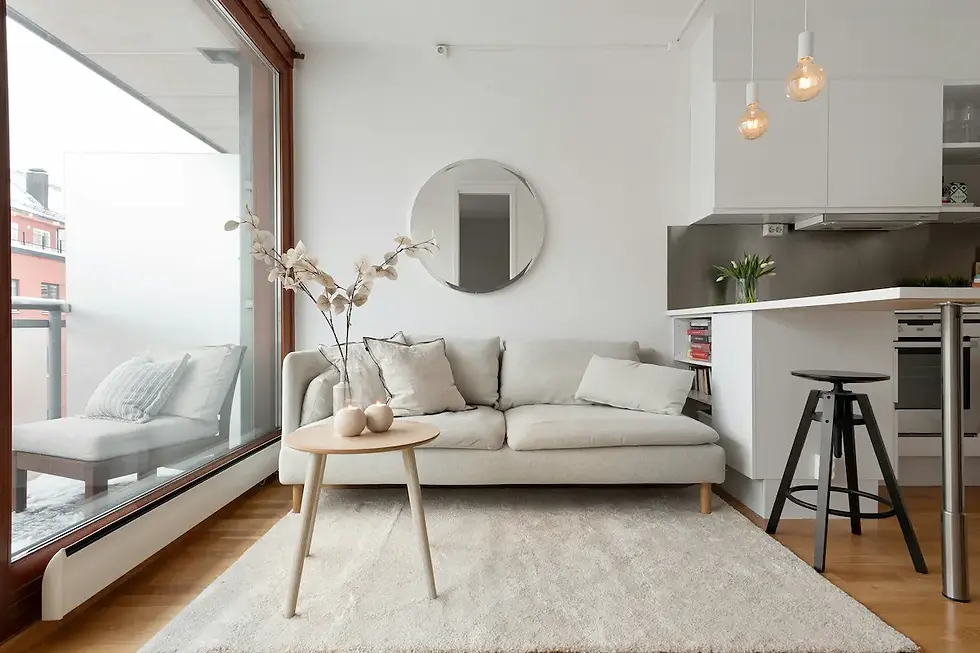
Whichever you choose, two small moves do most of the work. A flat-weave, washable rug anchors the seating zone and tells the eye where the "living room" is in an open studio - a low-pile washable rug survives the same spills your sofa does. And a lumbar pillow is non-negotiable on the Owen's low back - it turns a lounge sofa into one you can also sit upright on, which in a one-room apartment you'll do every single day.
Beyond that, restraint wins: one warm-toned throw, a single side table, and stop. If you're zoning an open studio around the sofa, I walk through the exact moves in how to zone a studio without walls, and there's more layering I lean on in my small-apartment decorating ideas.
Buy the sofa for the life you actually live. Style it for the room you actually have. That's the whole game. Love our ideas? Let's bring them into your home. WarmCazza now designs rooms like this, remotely - your own concept, layout and shopping list. Explore E-Design → This article was written by WarmCazza and is informed by established interior design theory, visual perception research, and current global residential design trends. All recommendations reflect US retail availability as of June 2026 © WarmCazza All Rights Reserved.


Comments