
Turkish Furniture for USA Buyers: Is It Good Quality?
This article has no affiliate links. MODEF Expo invited me as a hosted visitor. Every photo here is mine.
I’m writing this from İnegöl, a furniture town in northwest Türkiye (the country’s official name, though you’ll still see “Turkey” on plenty of labels). I’m spending three days at MODEF Expo 2026. The fair is in its 55th edition, which makes it one of the longest-running furniture trade shows in the country, and the organizers invited me to look at Turkish furniture the way an American shopper would.
I came with one question. Is this furniture actually well made, and would I put it in a US home? For the showrooms that fit my warm minimalist taste, the answer is yes. Below is what I saw, what I checked, what it costs to bring a piece home, and where I’d still be careful.

What Is MODEF Expo?
MODEF Expo is a furniture and interior design trade fair in İnegöl, a town in Bursa province southeast of Istanbul. Turkish manufacturers build full showrooms inside the fair center, and buyers from other countries walk through them one room at a time.
Edition: 55th
Dates: October 13 to 17, 2026
Venue: Hikmet Şahin Culture Park fair center, İnegöl
Size: about 28,000 square meters, or roughly 300,000 square feet
Source: MODEF Expo 2026 event listing
The location matters. A 2022 Monocle report counted about 2,000 furniture manufacturers and 40,000 furniture workers in a town of roughly 180,000 people. In 2024, İnegöl exported about $630 million worth of furniture, close to 16% of Türkiye’s furniture exports that year, according to the İnegöl Chamber of Commerce.
The town has supplied timber since Ottoman times. Today, plywood mills, foam makers and hardware suppliers all sit a short drive from the factories. When the frame, the foam and the fittings come from down the road, a maker can keep an eye on every layer of the piece.
How I Checked the Furniture
There were more showrooms than I could see in three days, so I set one rule. I skipped anything gold, crystal or high-gloss and went into every room that could work in a warm, calm American home.
In each one, I sat on the sofas and chairs, pressed into the cushions, touched the fabrics, ran my hand along the wood finishes, and looked at the backs and undersides. Then I asked the people in the booth what the frames were made of, whether the wood was solid or engineered, how dense the foam was and where the fabric came from.
Every one of them answered on the spot and in detail. Nobody fell back on “premium quality,” which is more than I can say for a lot of stores back home.
Why Turkish Furniture Is Worth a Look for American Buyers
The wood is real
The pieces I liked were made of wood you could see and feel. On the dining table below, the grain runs across the whole top, and the base is a separate sculptural piece instead of four plain legs. I’ve written about why I gave up on flat-pack bedroom furniture, and most of what I saw in these showrooms was the opposite of that.

You can see the handwork
Cane set into curved frames. Leather straps with stitched edges. A side table base turned on a lathe until it flares out like a vase. Details like these take time, and a factory racing to the lowest price leaves them out.

The upholstery is a strong point
I saw speckled bouclé, thick chenille and cut velvet, mostly in warm neutrals and earthy colors. Fabric books were out for buyers who want a custom cover. If you’re stuck choosing a texture, my bouclé vs linen breakdown covers how each one holds up.
The lounge chair below shows what I mean. The wood frame is shaped around the arms and legs, the bouclé is finished with a dark contrast welt, and a padded footrest pulls out on a metal arm, so it works as both a reading chair and a chaise.

The design already fits American homes
Rounded corners, soft shapes, walnut tones, terracotta walls and white ceramics were everywhere. High-end US stores charge a lot for this exact look, and it’s the one I chased in my budget picks for the curved, wood-heavy look. According to Monocle, many İnegöl companies now hire their own designers, and it shows.

Türkiye already ships plenty of furniture to the US
In 2025, Türkiye was the world’s seventh-largest furniture exporter, and the United States was its fourth-biggest market after Iraq, the UK and Germany. Those figures come from the head of Türkiye’s woodworking craftsmen’s federation, as reported in the Turkish press. Plenty of these makers already know how to ship a sofa across an ocean.
What about tariffs?
Upholstered wooden furniture from Türkiye pays a 25% US tariff under Section 232. A proclamation signed on December 31, 2025 pushed the planned increase to 30% back to January 1, 2027 (source). The UK, EU and Japan negotiated lower caps. Türkiye didn’t.
What Türkiye does avoid is the extra duty aimed at China. Wooden bedroom furniture from China has been under a US antidumping order for years, and as of August 2026 the China-wide cash deposit rate stands at 216.01% (Commerce case A-570-890). My guess, and it’s only a guess, is that this will bring more Turkish-made furniture into US stores.
Where I’d be careful
With around 2,000 makers in one town, quality isn’t even. Monocle described quality as İnegöl’s old weak spot, and I’m sure you can still find weak pieces here. I filtered hard on the show floor, and you should do the same at home with the checklist below.
5 Pieces That Would Work in a Warm Minimalist Home
The curved sideboard
Of everything I photographed, this sideboard shows the warm minimalist look best. A matte taupe shell wraps over the top and around both ends in one continuous curve, and four dark wood-grain doors sit inside it with no handles at all. It stands on two flat legs set well in from the ends, so from across the room it seems to float a few inches off the floor.
It’s long and low, so it can work as a dining room buffet or a media console. I’d hang one large mirror above it, keep two or three objects on top and leave the rest of the wall alone. With handleless doors, check how they open before you buy. Push-to-open hardware is easy to live with, but it’s worth testing a few times in person.

The woven leather lounge chair
Wide brown straps are woven in a basket pattern over a dark wood frame, and the chair sits low and leans back. If you buy a chair like this, ask whether the straps are genuine leather, because real leather softens and darkens nicely with use. Set it on a light wool rug (my rug guide covers which ones work) and let it be the darkest thing in the room.
Low lounge chairs are lovely to read in, but they’re harder to get out of. If anyone in your home has bad knees, sit in one for a few minutes before committing.

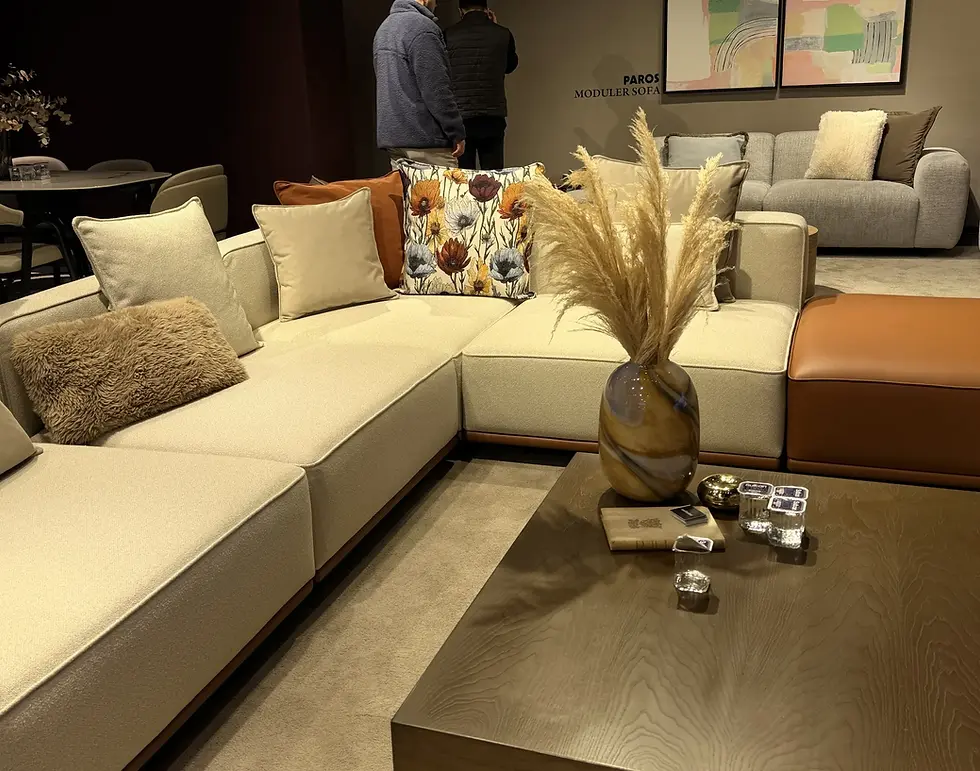
The cream modular sectional
Separate modules sit on a recessed base trimmed in tan leather, styled here with a cognac leather ottoman and dried pampas. Modular makes sense for American homes that change often, since you can rearrange it after a move instead of replacing it. One practical note: separate modules also fit through narrow doorways and up apartment stairs far more easily than a one-piece sofa.
The paisley armchair
This one is cream bouclé with a brown paisley pattern and a contrast welt along the rounded back. In two warm tones, the pattern stays quiet enough for a minimalist room. It’s a good example of why I stopped matching my furniture. Put it across from a plain sofa and pull one color from the pattern into a pillow or throw.

The cane armchair
Each side is a rounded frame of walnut-toned wood with cane panels set inside it. The seat and back are covered in cut velvet in rust, ochre, brown and cream blocks, with a matching lumbar pillow. It’s the boldest piece on this list, and I’d still use it as the only patterned chair in an otherwise plain room. For a lighter, beachier take on cane, see my cane and rattan picks.
How to Check Turkish Furniture Before You Buy
These are the questions I asked at the fair, adjusted for ordering from the US.
What’s the frame made of? Ask whether it’s solid wood, plywood, MDF or particleboard, and which species. “Wood” alone tells you nothing. Plywood in a sofa frame isn’t a red flag if it’s thick and well joined, but particleboard in a load-bearing part is.
How dense is the foam? Turkish sellers quote foam density as “dansite,” in kilograms per cubic meter. US brands use pounds per cubic foot. To convert, divide the Turkish number by 16. A 32 dansite foam is about 2 pounds per cubic foot. Compare that against the spec of any US sofa you’re also considering.
What’s the rub count? Turkish and European makers usually test fabric with the Martindale method, which rubs it in a figure-eight pattern. US brands use Wyzenbeek double rubs, a back-and-forth test. The numbers don’t convert, so compare like with like. For reference, the contract textile industry’s guidelines call for 20,000 Martindale cycles or 15,000 Wyzenbeek double rubs for low-traffic commercial seating, and 40,000 or 30,000 for high traffic (ACT guidelines). Those are commercial benchmarks, so they set a demanding bar for a home sofa.
Is it real veneer? Look at the edges and corners. Real veneer has grain that wraps around naturally, while printed foil repeats its pattern and peels at the seams.
Does it have the US flammability label? Upholstered furniture made or imported for the US since June 25, 2021 must meet the federal standard based on California’s TB 117-2013 and carry a permanent label (Federal Register).
Is it sized for American homes? Turkish beds are metric, often 160 x 200 cm, which doesn’t match a US queen at 60 x 80 inches. Ask for US-sized versions, and get every dimension in inches before you order.
Who handles delivery, warranty and returns in the US? Get the lead time in writing. The terms I compare in my guide to furniture shops in the US make a good benchmark.
Turkish Furniture Terms to Know
If you ever get a spec sheet or product page straight from a Turkish maker, these are the words that tell you what you’re buying.
Masif: solid wood
Kayın: beech
Gürgen: hornbeam
Meşe: oak
Ceviz: walnut
Fırınlanmış: kiln-dried, as in “fırınlanmış kayın” for kiln-dried beech
Kaplama: veneer
Lake: lacquer finish
Sünger: foam
Dansite: foam density, in kilograms per cubic meter
Elastik kayış: elastic webbing under the seat cushions
Kumaş: fabric
Deri: leather
Suni deri: faux leather
Viyana hasırı: cane webbing, literally “Vienna straw”
“Masif ceviz” means solid walnut. “Ceviz kaplama” means walnut veneer over another material. That one word changes the price, and it should.
What the Price Tag Doesn’t Include
If you buy from a US store that carries Turkish furniture, the shipping and import costs are already built into the price. If you order directly from a maker in Türkiye, the factory price is only the start. Plan for:
Ocean freight from Türkiye to a US port
US import duty, including the 25% Section 232 tariff on upholstered wooden furniture, on top of the regular duty for that product
A customs broker to file the import paperwork
Port and handling fees once the shipment lands
Delivery to your home, plus white-glove service if you want it carried in, unpacked and placed
Made-to-order upholstery also takes weeks to build before it ships, and the ocean crossing adds more. Before you pay a deposit, ask for a quote “delivered duties paid,” often written as DDP. That means the seller covers freight and import costs to your door, so the number you agree on is the number you pay.
How to Care for These Materials
The pieces I liked use materials that last for years if you treat them right.
Bouclé: Vacuum it regularly with an upholstery brush, and blot spills instead of rubbing. The loops can snag on pet claws and jewelry.
Cane: Keep it out of direct sun and away from radiators, which dry it out. Dust it with a soft brush and wipe it with a barely damp cloth.
Leather: Condition it a couple of times a year and keep it out of strong sunlight so it doesn’t fade or crack.
Velvet: Brush the pile in one direction and flip or rotate cushions so they wear evenly.
Matte lacquer: Wipe it with a soft, damp cloth. Skip abrasive cleaners and polishes, which can leave shiny patches on a matte finish.
Where to Buy Turkish Furniture in the US
For the specific pieces in this article, I don’t have a confirmed answer yet, and I’d rather not guess. I’m asking every maker I met about US stockists, dollar prices and delivery times. When I have confirmed answers, I’ll add them here and change the date at the bottom of the page.
In the meantime, you can find Turkish-made furniture already sold in the US by checking where a piece was made. US customs law requires imported goods to be marked with their country of origin, so look for “Made in Türkiye” or “Made in Turkey” on the label or box. Many product pages list it too. Then run the piece through the checklist above.
Turkish Furniture FAQ
Is Turkish furniture good quality?
The best of it is very good. At MODEF Expo 2026, I saw real wood, careful upholstery and handwork like cane and stitched leather. Quality varies a lot from maker to maker, so ask about the frame, foam and fabric before you buy.
Where is most Turkish furniture made?
Istanbul is the country’s biggest furniture export hub. Next comes Bursa province, home to İnegöl, followed by İzmir, Kayseri and Gaziantep. İnegöl alone exported about $630 million in furniture in 2024.
What is MODEF Expo?
It’s an international furniture and interior design trade fair in İnegöl, Türkiye. The 55th edition runs October 13 to 17, 2026, on about 28,000 square meters, with Turkish makers showing full showrooms to foreign buyers.
Do US tariffs apply to furniture from Türkiye?
Yes. Upholstered wooden furniture from Türkiye pays a 25% Section 232 tariff, which is set to rise to 30% on January 1, 2027. The antidumping duties on Chinese wooden bedroom furniture don’t apply. Tariffs change often, so check before you order.
How do I convert Turkish foam density to US numbers?
Divide the dansite number by 16 to get pounds per cubic foot. For example, 32 dansite is about 2 pounds per cubic foot and 40 dansite is about 2.5.
Does Turkish furniture work in a warm minimalist home?
Yes, if you skip the glam side of the market. Look for matte finishes, natural wood, textured neutral fabrics and soft curves.
TL;DR
I toured MODEF Expo 2026 in İnegöl as an invited visitor and only went into showrooms that fit a warm minimalist home.
The best pieces had real wood, visible handwork and great upholstery, in a curved, warm style Americans already buy.
İnegöl has about 2,000 furniture makers and exported around $630 million in furniture in 2024.
Turkish upholstered furniture pays a 25% US tariff, but none of the China-specific antidumping duties.
Before buying, check the frame, foam density, rub count, veneer, US flammability label, sizing and warranty.
Ordering direct? Ask for a delivered duties paid (DDP) quote.
Where to buy these exact pieces: coming in an update. About Nina Sajaia
Nina Sajaia is the founder of WarmCazza and has been writing about interiors, slow living, and the psychology of home since 2021. Her work on Japandi and Warm Minimalism has been shared across interior design communities in Europe and the US. She has assembled more IKEA furniture than she would like to admit and has strong opinions about which brands do it better. This article was written by WarmCazza and is informed by current US furniture market research, assembly testing, and 2026 interior design trend analysis. © WarmCazza - All Rights Reserved.


Comments