
How to Zone a Studio Without Walls: 7 Ideas (2026)
Updated: Aug 31
This post contains affiliate links. As an Amazon Associate I earn from qualifying purchases. If you purchase through these links, I may earn a small commission at no extra cost to you.
The 7 best ways to zone a studio without walls: open bookshelf perpendicular to the sleeping zone (minimum 150cm tall, open-back on both sides), distinct area rugs per zone (jute in living zone, plush wool or boucle in sleeping zone), ceiling-mounted linen curtain track (floor-to-ceiling, always linen - never synthetic sheers), floating sofa 40–60cm from the wall with a narrow console behind it, zone-specific lighting (2700K sleeping, 2700–3000K living, 4000K work), freestanding rattan or oak room screen at the foot of the bed, and one accent wall behind the bed in warm matte terracotta, dusty sage, or greige. The most effective combination: open bookshelf + distinct rugs + lighting zones. Three zones is the practical answer - sleeping, living, work. The problem was never the square footage. It was the undecidedness of the space.
Let me tell you about the worst six months of my design life.
I had just moved into a 58 sq. m. studio and I was convinced convinced that I knew exactly what I was doing. I write about interiors for a living. I had opinions about grout color. I knew the difference between warm white oak and cold ash. I was fine.
I was not fine.
My bed was three feet from my "living room." My desk shared air with my kitchen. Every morning I woke up staring at my laptop. Every evening I tried to relax on a sofa that was technically in my office. I couldn't work because I felt like I was in bed. I couldn't rest because I felt like I was at my desk. Everything was everywhere, and nowhere felt like anything.
It took me about four months to understand that the problem wasn't the size of the space. It was the undecidedness of it. One room asked my brain to do everything at once and my brain, reasonably, refused to do any of it well.
If you've been reading my work on quiet luxury kitchens and warm minimalist design, you already know that I believe one principle above everything else: every element in a space should know its job. A kitchen that zones cooking from socializing feels better to be in. A studio that zones sleeping from living changes your entire relationship with home. This transformation relies on the core principles of warm minimalism a design approach that prioritizes comfort and intentionality over stark, empty spaces.
If you've been searching for how to zone a studio without walls, here's what actually works.

Why Zoning a Studio Apartment Matters More Than You Think
There's a term designers use spatial fatigue and it's exactly what it sounds like. When every visual cue in your space is competing for attention, your brain never fully shifts into any single mode. You can't relax completely because the desk is visible. You can't focus completely because the bed is right there.
This isn't a willpower problem. It's an environmental design problem. It’s about mastering the same functional strategies I explored in my guide to Small Apartment Decorating Ideas, where the goal is to make every square meter serve a clear purpose. And in 2026, with urban apartment sizes continuing to shrink and remote work making the home-as-office reality permanent for millions of people, it's one of the most searched interior design topics on the internet for good reason.
The solution isn't walls. It's intentional design the same principle that makes a well-zoned open-plan kitchen feel coherent rather than chaotic. Fewer visual decisions, each one doing more work.
Studio Apartment Layout: Plan Your Zones First
Before you buy a single divider, plan the studio apartment layout on paper. Most studios work best as three zones - sleeping, living, and work - arranged so the bed sits furthest from the entry and the desk catches the best daylight. Decide where each zone lives first; the dividers below simply make those decisions visible.
7 Warm Minimalist Ideas to Zone a Studio Without Walls
1. The Open Bookshelf Divider - The Classic That Always Works
Why it works: An open bookshelf placed perpendicular to a wall creates a physical boundary without blocking light or air. Your eyes register it as a room edge while the space stays visually connected. It's the most searched studio room divider idea for a reason it's practical, renter-friendly, and effective in almost every layout.
The dimensions that matter: Minimum 150 cm tall, ideally 180–200 cm for real zone separation. Anything shorter reads as furniture, not as a boundary. Width of 80–120 cm is enough to anchor a zone without dominating it.
Go open-back on both sides. Solid-back bookshelves function like actual walls and shrink the space. Open backs maintain light flow and visual depth the space feels divided and connected simultaneously, which is exactly what you want.

What goes on the shelves: The living-room-facing side gets curated objects a trailing plant, a few books stacked horizontally, one ceramic piece, nothing more. The bedroom-facing side holds functional items: a small lamp, a candle, your current book. Two different moods. One piece of furniture.
If your kitchen uses white oak, warm walnut, or matte black metal, carry that material into your bookshelf choice. Consistency across zones is what makes a studio feel designed rather than assembled. This visual continuity is just as vital here as it is in an open concept kitchen, where the transition between cooking and living areas must feel seamless yet defined.
Nina's Note: I used the IKEA KALLAX 4×4 as my bedroom separator for two years. Books on the living room side, my nightstand items on the bedroom side. I know it sounds too simple to matter. It completely changed how the apartment felt. Suddenly I had a bedroom not a sleeping corner, an actual bedroom. If you want better wood finishes than IKEA offers, my guide on stores similar to IKEA covers several that carry open shelving in warm oak and walnut at comparable prices.
Where to find it: IKEA KALLAX or BILLY for budget. Article and CB2 for warmer wood tones that don't look flat-pack.
2. Area Rugs - The Cheapest, Most Underrated Zone Divider
Why it works: A rug is a floor-level room marker. Place one under your sofa and coffee table, a different one in the sleeping zone, and your brain automatically registers two separate spaces. No furniture moved. No walls built. The rug does all the work.
The layering approach for warm minimalism:
Living zone: Low-pile natural jute or sisal, 200×300 cm minimum. Your sofa legs should sit on the rug not float in front of it. A rug that's too small makes the zone look accidental, not intentional.
Sleeping zone: Higher-pile boucle, wool, or chunky cotton. Softer, warmer, texturally distinct. This is the tactile signal that you've entered a different room. Your feet register it before your eyes do.
Optional dining zone: A flatweave cotton or thin jute, distinct enough from the living rug to read as a third area.
The texture contrast is doing most of the psychological work here. Hard floor underfoot in the living zone, soft plush in the sleeping zone this is tactile zoning, and it's more effective than it has any right to be. If you're torn between jute, wool, or a washable for each zone, my guide to choosing the right rug material compares them all by feel, durability, and price, with the honest downsides included.
Nina's Note: I noticed the shift within the first evening. Stepping from the jute in my living area onto the wool rug next to my bed, my whole body registered a change. The space hadn't moved, but my experience of it completely had.
Where to find it: West Elm for natural-fiber rugs in warm neutrals. IKEA's STOENSE (soft, budget) and TIPHEDE (flatweave jute) work well as a living/sleeping contrast pair.
3. Curtain Dividers - The Most Flexible Room Divider for Studios
Why it works: Ceiling-mounted curtain tracks give you a moveable wall on demand. Open during the day for a light, airy feel. Close at night for genuine privacy in the sleeping zone. No permanent installation required with a freestanding rod.
Floor-to-ceiling linen does something no other material quite manages it diffuses light rather than blocking it. Even when the curtain is drawn, the sleeping zone stays warm and luminous rather than dark and closed-off. It moves with air. It makes a space feel considered.

For renters: Adhesive ceiling-mounted curtain tracks leave no damage and are widely available. For those who can drill, IKEA's KVARTAL system costs under $60 and transforms the feel of a space immediately. Choose undyed or warm-toned linen avoid synthetic sheers, which look cheap the moment light hits them directly.
If your kitchen uses linen Roman shades or any soft textile element, carry that material through to your curtain divider. The repetition is what makes a studio feel like it was designed from end to end rather than decorated room by room.
Nina's Note: Heavy blackout curtains as dividers make the closed zone feel like a storage closet. Linen is the answer. Always linen. It's the one material that functions as a room divider while actively making a space feel more beautiful at the same time.
Where to find it: IKEA KVARTAL for the track. West Elm and CB2 for quality linen panels in warm neutral tones.
4. Floating Furniture Placement - The Free Zone Divider
Why it works: A sofa with its back facing another zone is one of the most effective and completely free ways to divide a studio without walls. The sofa back creates a visual boundary. The space behind it becomes a separate zone.
Most people push all furniture against the perimeter walls to "maximize the middle." The result is a large empty floor area and a room that looks like a waiting room. Floating furniture creates depth your eye moves through the space rather than bouncing off the edges.
The specific distances that work:
Pull your sofa 40–60 cm from the wall behind it. This gap creates the sense of a back "wall" to the living zone without sacrificing significant floor space.
The space between sofa and wall becomes your secondary zone desk, dining table, or sleeping area.
Add a narrow console table (25–35 cm deep) directly behind the sofa. This reinforces the boundary, gives you a functional surface, and signals that the placement is intentional. A console that doubles as a desk or a drop-leaf that folds flat is exactly the kind of two-in-one piece a studio rewards - I pulled together the best multifunctional furniture for small spaces if you want the specific pieces.
This is the same principle as a kitchen island that separates cooking from dining one central element, everything arranged around it.

Nina's Note: I know pulling furniture away from the wall feels wrong in a small space. It felt completely wrong to me. Then I did it. My studio looked noticeably larger. Not because there was more space because the space had direction. The eye traveled through it instead of stopping at every wall.
Where to find it: Article's Sven sofa in warm boucle or natural linen works well in floating arrangements. CB2's compact Flex series for smaller footprints.
5. Layered Lighting Zones - The Most Powerful Invisible Divider
Why it works: A single overhead ceiling light illuminates the entire studio equally flattening every zone, visually unifying the whole space. Zone-specific lighting at different color temperatures makes each area feel genuinely distinct, even when nothing physically separates them.
Color temperature by zone:
Sleeping zone: 2700K. This is the temperature of candlelight amber, deeply warm, biologically signals rest. A single bedside lamp at 2700K next to a brighter living zone is enough to make the sleeping area feel like a different room.
Living zone: 2700–3000K. Warm but slightly more present. A floor lamp beside the sofa plus a table lamp on the coffee table two sources, same zone.
Work zone: 4000K. Cool, directional, focused. The contrast with your 2700K sleeping zone reinforces the psychological separation between rest and work more powerfully than any physical object.
Kitchen: 3000K over the counter or island consistent with the living zone, slightly more task-oriented.
Turn the overhead off. Use the zones. The same studio becomes four distinct spaces.
This is the same 2700K principle I cover in kitchen lighting ideas 2026 warm light over a kitchen island changes how the whole room feels. It works identically in a living zone.
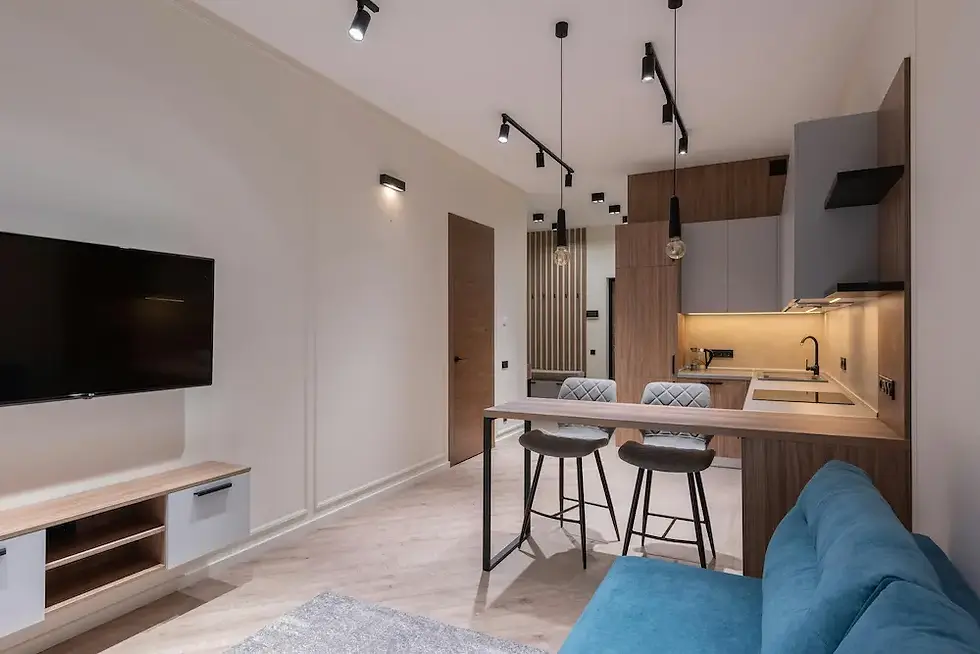
Nina's Note: Smart bulbs are worth every penny in a studio. Switching from "work mode" (4000K at the desk) to "living mode" (2700K floor lamp) with one tap genuinely changes how the space feels and how you feel in it. Your nervous system responds to light temperature before you're even conscious of it.
Where to find it: West Elm for arc floor lamps and ceramic table lamps in warm tones. IKEA's RANARP for task lighting with a warm finish.
6. Room Screen or Temporary Partition - Physical Privacy Without Construction
Why it works: Freestanding room screens offer actual physical privacy without construction. Renter-friendly, moveable, and increasingly available in materials that belong in a home rather than a corporate waiting room.
For warm minimalism: Natural materials only rattan, light oak, or linen panels on a simple frame. Rattan and natural cane are particularly effective because they're visually permeable: light passes through, so the sleeping zone stays luminous rather than boxed-in, while still creating enough visual interruption to register as a boundary. This is the same logic as open kitchen shelving structure without weight.

Dimensions that work as a divider: Minimum 150 cm tall, 90–120 cm wide. Shorter or narrower reads as an accent piece, not a zone boundary.
Placement tip: A screen at the foot of the bed rather than the side creates a threshold you step into the sleeping zone instead of rolling over from the sofa. This spatial ritual matters more than it sounds.
Material echo: If your kitchen has rattan basket inserts on open shelves or a natural cane cabinet front, carry that material through to your screen. If you have a light oak kitchen island, match it in the screen frame. These repetitions are what transform a studio from "a room with furniture" into a home that feels considered.
Nina's Note: The most underrated thing about a room screen is that it works in both directions. From the living side, it's a design element. From the bedroom side, it's a sense of enclosure and in a studio, that feeling of being in a room rather than in a corner of a room is everything.
Where to find it: CB2 for warm-toned, refined screens. Article for rattan and natural cane at mid-range prices. More options in my best furniture stores in the USA guide.
7. Color Zoning - The Studio Divider You Paint On
Why it works: Paint the wall behind your bed a different color from the rest of the apartment. Your brain registers it as a separate room. This is the most dramatic transformation per dollar on this entire list and the most consistently underused.
You don't repaint everything. One wall. The wall that anchors the sleeping zone. The contrast creates a visual destination: a room within a room. And unlike every other idea here, it works while you sleep, permanently, with zero furniture budget.
The warm minimalist color palette for 2026:
Terracotta / warm clay - the strongest choice for a sleeping zone. Grounding, earthy, genuinely warm. Works with white oak, natural linen, warm brass. If your kitchen has terracotta tile or warm clay elements, this echo across zones makes the whole studio feel architecturally coherent.
Dusty sage / muted olive - quieter, softer. Botanical without being trendy. Pairs beautifully with sage-green kitchen cabinets if that's your direction.
Warm greige / sand - the most versatile option. Slightly deeper than your main walls, creates separation without drama. Works in any studio regardless of existing finishes.
Deep warm taupe / mocha - the most sophisticated choice. Rich without being dark, warm without being orange. Requires good natural light.
One technical note: always matte finish. Matte absorbs light softly, making the wall feel like it recedes into warmth. Eggshell and satin reflect light back it's a small difference that completely changes the feeling.
Avoid cool colors in sleeping zones. Grey-blue, stark white, cool green they feel clinical rather than restful and actively undercut every warm element you've built elsewhere.
For renters: Removable wallpaper has genuinely improved. Chasing Paper and Tempaper offer textured options grasscloth-effect, linen-weave that add tactile depth flat paint can't replicate.
Nina's Note: Warm muted tones consistently outperform bright and cool choices for spaces that feel comfortable rather than stimulating. When you choose the same color family for your kitchen and your bedroom accent wall, your studio stops feeling like a series of separate design decisions and starts feeling like a home that was always meant to look this way.
Where to find it: Clare Paint and Backdrop for thoughtful warm palettes. Chasing Paper for removable wallpaper in textured, muted tones.
How to Combine These Ideas: A Simple Studio Layout Framework
The real power is in layering. Here's a practical starting point:
In a studio apartment layout, place the sleeping zone furthest from the entry and the work zone nearest the best daylight, then layer the dividers below.
Sleeping zone: Open bookshelf or curtain as physical divider → accent wall in warm terracotta or sage (matte finish) → plush wool or boucle rug → single 2700K bedside lamp, nothing else
Living zone: Floating sofa 40–60 cm from the wall → natural jute rug with sofa legs on it → arc floor lamp at 2700–3000K → narrow console behind sofa as zone boundary
Work zone: Desk positioned behind sofa back → directional lamp at 4000K → separated from every other zone by light temperature alone.
You don't need all seven ideas. Two or three, layered with intention, will change how your studio functions and how you feel in it every day.
Quick Comparison: Which Idea Is Right for You?
# | Idea | Estimated Cost | Privacy Level | Best For |
1 | Open Bookshelf | $80–$300 | Medium | Defining sleeping zone while keeping light |
2 | Area Rugs | $50–$400 | Low | Budget-first zoning, tactile separation |
3 | Curtain Divider | $60–$200 | High | Maximum privacy, renter-friendly |
4 | Floating Furniture | $0 | Low–Medium | Free solution, immediate visual impact |
5 | Lighting Zones | $50–$300 | Low | Psychological separation, mood control |
6 | Room Screen | $100–$500 | Medium–High | Texture, warmth, and privacy combined |
7 | Color Zoning | $30–$150 | Low | Most dramatic visual impact per dollar |
How to read this: Privacy is your priority → start with #3 (curtain) or #6 (screen). Budget is the constraint → start with #4 (free) or #7 (one wall of paint). Want the most complete transformation → combine #1 + #2 + #5. Bookshelf, rugs, and lighting together cover physical, tactile, and psychological zoning simultaneously.
FAQ: Zoning a Studio Apartment Without Walls
What is the best way to zone a studio apartment without walls?
The most effective combination for most studios is an open bookshelf as a physical divider paired with distinct area rugs in each zone. The bookshelf creates a boundary while maintaining light; the rugs reinforce separation through tactile contrast. Add zone-specific lighting 2700K for sleeping, 4000K for work and you have three genuinely distinct zones without a single wall built.
How do I separate a bedroom in a studio apartment?
Place a tall open bookshelf (minimum 150 cm, ideally 180–200 cm) or ceiling-track linen curtain perpendicular to the sleeping area. Add an accent wall behind the bed in a warm muted tone terracotta, dusty sage, or warm greige, always matte finish. Use a plush rug in the sleeping zone only, and limit the light source there to a single 2700K bedside lamp. This combination creates enough visual and sensory separation that the sleeping zone functions psychologically as a separate room.
What are the best room dividers for studio apartments in 2026?
Based on search data and practical experience: open bookshelves (IKEA KALLAX is the benchmark, carry better wood-finish alternatives), ceiling-mounted linen curtain tracks, and freestanding screens in natural rattan or light oak. For warm minimalist aesthetics, material matters as much as function the divider should feel like part of the design, not a barrier imposed on it.
Can I zone a studio without damaging walls for renting?
Yes, every idea in this article is renter-friendly. Freestanding bookshelves, area rugs, and room screens require zero installation. Adhesive ceiling curtain tracks leave no damage. Removable wallpaper replaces paint convincingly. The only technique that may need landlord approval is a drilled ceiling curtain track most landlords agree, but always worth asking first.
How many zones does a studio apartment actually need?
Three is the practical answer for most studios: sleeping, living, and work. Dining can often be combined with the living zone (a console table doubles as a dining surface) rather than treated as a fourth. More than four zones in a studio creates visual chaos the separation starts working against itself. Start with the sleeping zone first. It's the one that changes how the whole space feels most dramatically.
Love our ideas? Let's bring them into your home. WarmCazza now designs rooms like this, remotely - your own concept, layout and shopping list. Explore E-Design →
Final Thought
Here's what nobody tells you about living in a studio: the problem was never the square footage.
The problem is that one undivided room asks your brain to be in every mode at once resting, working, eating, living without any environmental signal about which one to choose right now. That's not a space problem. That's an information design problem. And it's completely fixable.
A bookshelf that says bedroom starts here. A rug that says this is where you rest. A lamp at 2700K that says the work day is over. These aren't decorating choices. They're instructions to your nervous system gentle, warm, and completely within your control regardless of your square footage or your lease.
The studios that feel like homes aren't bigger. They're clearer. Each zone knows what it is. Nothing competes for attention. Everything belongs.
Pick one idea from this list. One. Place the rug, hang the curtain, pull the sofa 50 cm from the wall. Then spend an evening in your space and notice what's different.
It won't feel like a studio anymore. It'll feel like yours.
About Nina Sajaia
Nina Sajaia is the founder of WarmCazza and has been writing about interiors, slow living, and the psychology of home since 2021. Her work on Japandi and Warm Minimalism has been shared across interior design communities in Europe and the US. She has assembled more IKEA furniture than she would like to admit and has strong opinions about which brands do it better.
This article was written by WarmCazza and is informed by current US furniture market research, assembly testing, and 2026 interior design trend analysis. © WarmCazza - All Rights Reserved.


Comments