
Open Concept Kitchen and Living Room Ideas 2026: 5 Rules
Updated: Jul 31
An open concept kitchen and living room works through 5 specific decisions - not by removing walls and stopping there. Rule 1: island anchor - minimum 4-foot depth, seating facing the living zone, darker base for visual weight. Rule 2: continuous flooring or flush inlay - never T-molding on primary sightlines. Rule 3: zone-specific lighting on separate dimmers - kitchen task, living ambient, transition overhead, all at 2700K–3000K. Rule 4: color threading - one base neutral at two depths (deeper in kitchen, lighter in living zone), one accent color echoed exactly three times across both zones. Rule 5: 8×10 minimum rug in the living zone, sofa back facing the kitchen. Ventilation: ducted range hood minimum 400 CFM - recirculating hoods return cooking smells to the space.

Most Open Concept Kitchen and Living Room Layouts Are Just Expensive Warehouses
You knocked down the wall in search of open concept kitchen and living room ideas 2026 that actually work. You got the light, the flow, the sightlines. And then you stood in the middle of your unified floor plan and felt absolutely nothing.
No warmth. No definition. Just one large, expensive room that can't decide what it is.
This is the "accidental open plan" and it's the most common interior design mistake in American homes right now. If you're rethinking your kitchen more broadly, 2026 Kitchen Design Trends covers where the biggest shifts are happening this year. But the open plan problem specifically comes down to one thing: people remove the walls and stop there.
The integrated living zone doesn't create cohesion. You do. With five specific decisions that define zones, control visual weight, and make every corner of the space feel intentional. This process of creating definition is essentially the same skill set required to zone a studio without walls it’s about using furniture, light, and texture to tell your brain where one room ends and another begins.
Rule 1: The Island Anchor - Your Psychological Bridge

The kitchen island is not a prep surface. It's the hinge point of your entire open layout.
In a well-designed integrated living zone, the island does three jobs: it contains the kitchen area, it faces the living zone, and it creates a transition between the two without a single wall. Designers call this a psychological bridge an object that tells the brain "the kitchen ends here, something else begins."
Scale matters more than style. The minimum for an open plan island is 4-foot depth, with seating on the living-room-facing side. This one detail seating that faces the sofa, not the cooktop transforms an island from a work surface into a social anchor.
Visual contrast is non-negotiable. A white island in a white kitchen disappears. Use a darker cabinet color or different countertop material on the island base to give it visual weight. Benjamin Moore Silhouette or Sherwin-Williams Iron Ore on an island base against lighter uppers creates exactly the kind of presence that makes the whole layout read as deliberate.
Nina's tip: I always tell clients if your island doesn't stop you when you walk in the room, it's not doing its job. Go darker, go heavier, go bigger. You can always add a light pendant above to balance it.
Rule 2: Flooring Transitions - The Detail That Makes or Breaks Everything
This is the most technically consequential decision in open layout design. Most homeowners treat it as a practical afterthought. It isn't. Before choosing your transition style, ensure you've selected the best kitchen floor materials that can withstand high-traffic cooking zones while still complementing the softer textures of your living area.
Transition Type | Best For | Avoid When |
Seamless Continuous | Maximum cohesion, visual expansion | High-moisture kitchens with solid hardwood |
Flush Inlay | Design-forward, architectural look | DIY installs — requires precision cutting |
T-Molding Strip | Level changes between materials | Visible from main sightlines reads unfinished |
Abrupt Change | Never | Always |
The 2026 recommendation: Continuous flooring wherever structurally possible. Wide-plank white oak or warm-toned LVP running through both zones eliminates the visual "stop" that makes integrated spaces feel fragmented. If different materials are unavoidable, a flush inlay turns a practical detail into a design feature.
The micro-zoning move: Want zone definition without changing materials? Use a directional shift herringbone in the kitchen zone, straight-laid planks in the living zone, same wood. The pattern change zones the space invisibly. Nina's tip: Home Depot and Lowe's will sell you T-molding as the default. It works. It also screams "rental renovation." If your floor plan is a design investment, spend the extra $300 on a specialty contractor for a flush inlay. You'll see it every day for the next decade.
Rule 3: Lighting Hierarchy - Zones, Warmth, and the Ventilation Problem Nobody Talks About
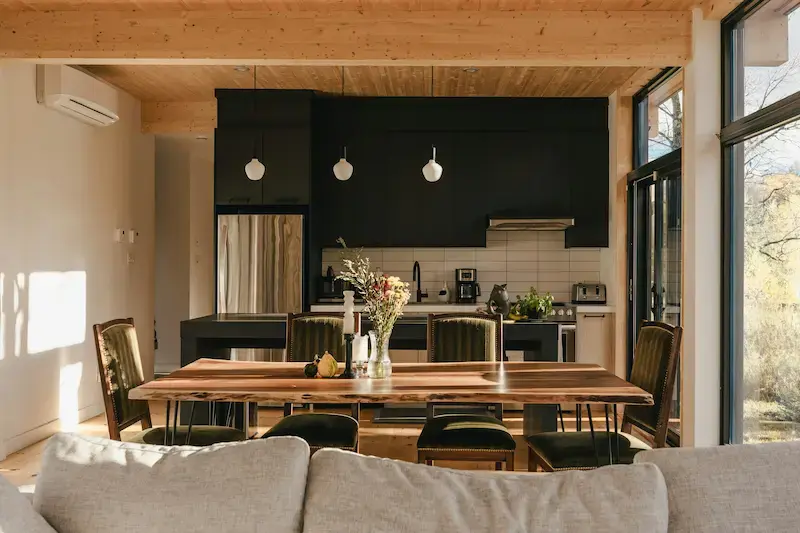
Every zone needs its own lighting layer. No two zones should share the same fixture type.
Kitchen zone: task light under-cabinet LEDs, recessed cans over prep areas, pendant over the island. Living zone: ambient light floor lamp, table lamp, or statement pendant over the seating area. Transition zone: its own overhead anchor a pendant or chandelier that signals "this is a third space."
Use the same color temperature throughout (2700K–3000K) but vary the fixture type and height per zone. Identical temperature creates visual cohesion. Different fixture types create zone definition. Both simultaneously that's the 2026 standard. The full technical breakdown on CRI, color temperature, and layered lighting is in Kitchen Lighting Ideas 2026. Every circuit on a separate dimmer. This is infrastructure, not a luxury.
Nina's tip: In my own flat, I have the kitchen pendants on one dimmer, the under-cabinet strips on another, and the living room floor lamp on a smart plug. Three switches, three moods. It cost me less than $100 to set up and it's the single upgrade I recommend to everyone.
The ventilation problem nobody solves: In an open layout, there are no walls to contain cooking smells. They travel directly into your sofa, curtains, and rugs. This is the number one complaint US homeowners have about open plan living.
The only real solution: a ducted range hood vented to the exterior, rated at minimum 400 CFM for gas, 300 CFM for electric. Recirculating hoods filter grease but return odors to the space. For open layouts over 400 square feet, add a supplemental HEPA + activated carbon air purifier at the living-room edge positioned to capture odors as they migrate, not after they've settled. A $200–$400 investment that protects every soft material in the room.
Rule 4: Color Threading - One Neutral, Two Depths
The most common color mistake in unified floor plan design: treating the two zones as separate rooms. The second most common: painting everything identically and calling it cohesion.
Color threading is the correct approach. One base neutral, deployed at two intensities. Kitchen gets the deeper version a warm greige on cabinets or walls that anchors the functional zone.
Living room gets the lighter version same family, two shades up that feels more expansive and residential.
A specific example: Benjamin Moore Pale Oak on living room walls. Benjamin Moore Muskoka on kitchen lower cabinets. Same undertone, same warmth, different depth. The eye reads "one cohesive space with two distinct areas."
Then add one accent color brass hardware, terracotta, a specific green and echo it in both zones. Island hardware and living room lamp base. Kitchen shelf ceramic and throw pillow. This is color echoing and it's the fastest way to make an integrated space feel professionally designed. The largest single color decision in the whole layout is the living-zone rug, and my rug guide covers how to choose one that carries the thread instead of fighting it, undertone first, pattern second.
Nina's tip: I pick my accent color last, not first. Get the neutrals right across both zones, then choose one metal finish or one textile color that I repeat exactly three times once in the kitchen, twice in the living room. Three repetitions feel intentional. Two feel accidental. Four feel forced.

Rule 5: Small Open Plan Hacks - When You're Working With Under 600 Square Feet
The rules above apply at any scale. The execution changes when square footage is tight. For a full toolkit on making compact spaces work harder, Small Apartment Design Tips 2026 covers the principles that apply beyond the kitchen-living combo.
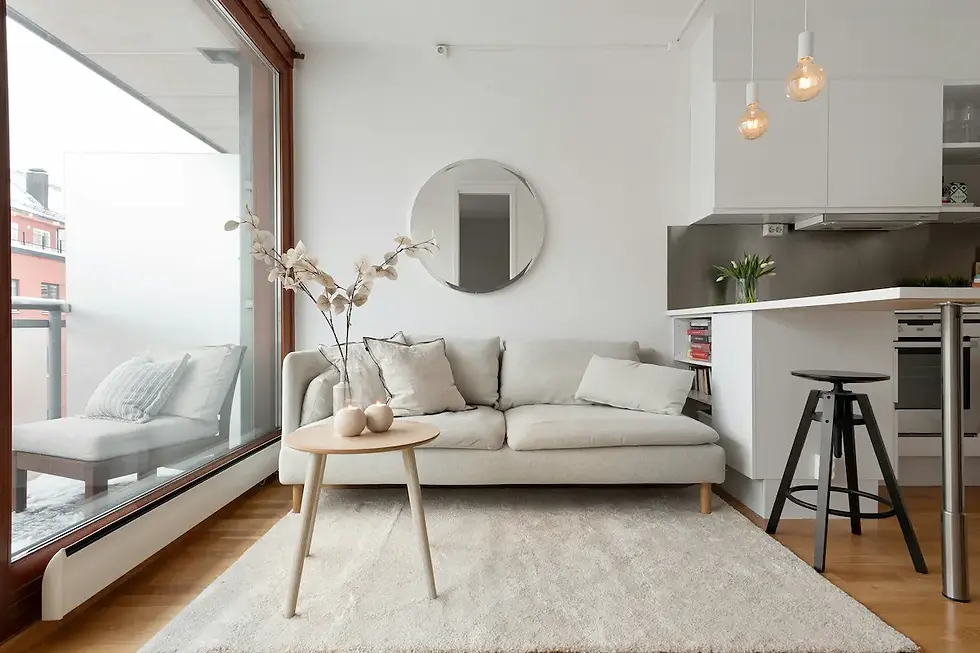
The rug rule: One large rug (8×10 minimum) in the living zone does more work than any other single purchase. It grounds the furniture, defines the zone, absorbs sound, and creates a visual boundary without any physical division. In a small unified floor plan, this is not optional it's structural. If you are working with an even tighter layout, these same principles are essential for anyone trying to effectively zone a studio apartment where every square foot must serve multiple purposes.
The sofa placement rule: Back of the sofa facing the kitchen, not pushed against the far wall. This creates an implicit zone boundary, gives the living area enclosure, and makes the layout feel designed. A console table behind the sofa completes the transition architecturally. For the sofa and seating pieces that work best in an open layout, my guide to the best places to buy living room furniture ranks ten stores by quality, price, and what each does best.
The vertical move: In small open layouts, go tall. Floor-to-ceiling cabinetry, tall pendants, high open shelving. Vertical emphasis draws the eye up and expands perceived space particularly effective in apartments and condos where ceiling height is underused.
Nina's tip: I live in 58m². My sofa back faces my kitchen. My rug is bigger than most people think is appropriate for the space. Both decisions made the flat feel twice as large as it is. Don't scale down your rug to match your square footage scale it up to match your ambition for the space.

Your Open Plan Integrity Checklist
Before you call the space finished and before you commit to a Kitchen Remodel Cost budget run through these six points:
Island has visual contrast, darker base or different material
Flooring is continuous or flush-inlaid no T-molding on main sightlines
Each zone has its own fixture type on its own dimmer circuit
Range hood is exterior-ducted, minimum 400 CFM
Color palette uses same neutral at two depths across zones
Living zone rug is 8×10 or larger
Open Concept Done Right: From Floor Plan to Home
The open concept kitchen and living room isn't a design style. It's a spatial condition that requires active management to feel like a home rather than a floor plan.
Apply all five rules and the integrated living zone stops being something you tolerate and starts being something you designed on purpose.
That's the difference between a house that's open and a home that's intentional.
Frequently Asked Questions
What are the best open concept kitchen and living room ideas for 2026?
Micro-zoning: using non-structural elements island position, rug placement, lighting fixtures, and color depth to define distinct zones without walls. The five key moves are island anchoring, continuous flooring, zone-specific lighting on separate dimmers, color threading, and rug anchoring. Applied together, they create a unified floor plan that feels designed rather than defaulted to.
How do you define zones in an open concept space without walls?
Five layered tools simultaneously: a kitchen island oriented toward the living space, a large area rug grounding the living zone, pendant lighting specific to each zone, the back of the sofa as an implicit boundary, and a two-depth color palette using the same base neutral. Each alone is subtle. All five together read as intentional.
How do you transition flooring from kitchen to living room?
Continuous flooring is the best option same material through both zones, no strip. If different materials are required, a flush inlay is the most design-forward solution. Avoid T-molding on primary sightlines.
How do you stop kitchen smells in an open concept space?
A ducted range hood vented to the exterior minimum 400 CFM for gas, 300 CFM for electric. Recirculating hoods return odors to the space. Add a HEPA + activated carbon air purifier at the living-room edge of the layout. Soft materials rugs, upholstered furniture, fabric window treatments absorb rather than reflect cooking smells.
What is the best sofa placement for a kitchen-living room combo?
Back of the sofa facing the kitchen, not pushed against the far wall. This creates a zone boundary and gives the living area enclosure. Add a console table behind it. In small open layouts, this placement visually separates both zones without any physical division.
Love our ideas? Let's bring them into your home. WarmCazza now designs rooms like this, remotely - your own concept, layout and shopping list. Explore E-Design →
About Nina Sajaia
Nina Sajaia is the founder of WarmCazza and has been writing about interiors, slow living, and the psychology of home since 2021. Her work on Japandi and Warm Minimalism has been shared across interior design communities in Europe and the US. She lives in a 58m² flat furnished from seven different stores none of which match, all of which she loves.
This article was written by WarmCazza and is informed by current US furniture market research, assembly testing, and 2026 interior design trend analysis. © WarmCazza - All Rights Reserved.

Comments