
Best Under-Sink Water Filters 2026: 5 PFAS-Free Picks
Updated: Aug 31
This post contains affiliate links. As an Amazon Associate I earn from qualifying purchases. If you purchase through these links, I may earn a small commission at no extra cost to you.
The 5 best PFAS-free under-sink filters in 2026: Cloud RO (~$400, best for Japandi and Warm Minimalist kitchens matte black faucet, built-in remineralization, app-connected), Waterdrop G3P800 (~$300, best for small apartments tankless, slim profile), Aquasana AQ-5300+ (~$150, best budget option removes 99% lead and PFAS), iSpring RCC7AK (~$219, best for wellness-focused homes adds minerals back), Clearly Filtered 3-Stage (~$250, best for zero water waste no RO membrane). Only filters certified to NSF/ANSI P473 are independently verified for PFAS removal. PFAS has been detected in over 45% of US tap water sources an under-sink filter also protects aged brass, matte black, and brushed gold faucet finishes from hard water damage.
My aged brass faucet cost $340. I installed it as the final touch in my kitchen refresh the kind of piece that makes the whole room feel intentional. Six months later, it was covered in white mineral buildup that no amount of vinegar would fully remove. I'd spent weeks choosing the perfect fixture but zero minutes researching the best PFAS-free under-sink filters to protect it from what was actually running through the pipes.
That was my introduction to hard water damage. And it's what eventually led me down a rabbit hole that most interior design blogs never touch: under-sink water filtration.

Why Your "Finished" Kitchen Isn't Actually Finished
Here's what the design world rarely says out loud: unfiltered tap water is quietly working against all of it. Integrating a high-performance filtration system is a key component of a smart-eco kitchen 2026, where home wellness and resource efficiency are built directly into the infrastructure of the space.
Limescale destroys aged brass, matte black, and brushed gold finishes over time
Chlorine affects the taste of everything you cook your broths, your teas, your pasta water
PFAS (forever chemicals) have been detected in over 45% of US tap water sources, according to a 2023 USGS study
Lead still leaches from older pipes in homes built before 1986 which includes a massive portion of the US housing stock. Just as we now prioritize non-toxic cookware to avoid chemicals in our food, ensuring the water used for boiling and steaming is free of lead and PFAS is the next logical step for a healthy kitchen.
An under-sink filter doesn't just clean your water. It protects your kitchen investment.
The Design-Wellness Bridge: Why Intentional Homes Need Pure Water
There's a reason Japandi design resonates so deeply right now. It's not just about wabi-sabi aesthetics or Scandi minimalism it's about intentionality in every layer of your home.
In traditional Japanese home culture, water quality is a wellness principle, not an afterthought. The concept of Ma (negative space, intentional emptiness) extends to what you put into your body. A Japandi kitchen with a cheap filtration pitcher sitting on the counter is a contradiction in design philosophy.
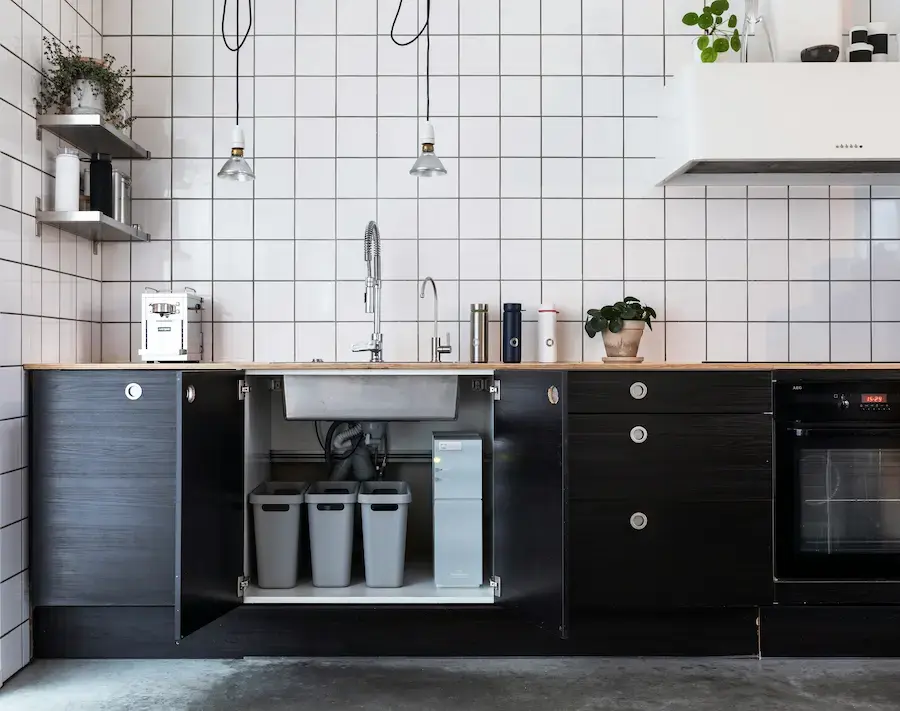
Under-sink filters solve this visually, too. Everything is hidden. The only thing visible is a slim, beautifully designed dedicated faucet available in every finish from matte black to aged brass to brushed nickel. Your countertop stays clean. Your design intent stays intact.
This is what I call invisible luxury: the upgrade nobody sees, but everyone tastes.
What to Actually Look for in 2026 (Not What the Packaging Says)
NSF Certifications That Actually Matter
Certification | What It Means |
NSF/ANSI 42 | Aesthetic improvements chlorine, taste, odor |
NSF/ANSI 53 | Health effects lead, cysts, VOCs |
NSF/ANSI 58 | Reverse osmosis performance |
NSF/ANSI 401 | Emerging contaminants pharmaceuticals, PFAS |
NSF/ANSI P473 | PFAS-specific certification (the gold standard) |
Pro tip: A filter that claims NSF "compliance" is not the same as NSF "certified." Always verify at NSF's official database.
Filter Types at a Glance
Carbon block (inline): Best for chlorine, taste, basic contaminants. Compact. Attaches to existing faucet. Perfect for renters.
Multi-stage carbon + ion exchange: Removes 200+ contaminants including heavy metals. No water waste.
Reverse osmosis (RO): Most thorough removes PFAS, microplastics, nitrates, fluoride. Requires tank or tankless unit.
RO + Remineralization: RO purity with minerals added back in. Best for taste and health balance.

Best PFAS-Free Under-Sink Filters of 2026: The WarmCazza Ranking
Ranked by filtration performance, design compatibility, and value for US homeowners.
Rank | Filter | Price | PFAS | Lead | Faucet Finishes | Best For |
1 | Cloud RO | ~$400 | 98% | ND | Matte black, brushed nickel | Japandi & Warm Minimalist kitchens |
2 | Waterdrop G3P800 | ~$300 | 97% | ND | Matte black, chrome | Small kitchens under 65m² |
3 | Aquasana AQ-5300+ | ~$150 | 99% | 99% | Brushed nickel, oil-rubbed bronze | Boho & French country kitchens |
4 | iSpring RCC7AK | ~$219 | 99% | 99% | Chrome, brushed nickel | Wellness-focused homes |
5 | Clearly Filtered 3-Stage | ~$250 | 99% | 99% | Brushed nickel | Mineral retention, no water waste |

Nina's Verdict: Which One for Your Kitchen?
Japandi or Warm Minimalist Kitchen
Cloud RO. App-connected, completely silent, built-in remineralization, and no wall outlet needed under the sink. The matte black faucet option looks stunning next to a walnut cutting board. This is the one I'd put in my own kitchen today.
Small Apartment Under 65m²
Waterdrop G3P800. Tankless means zero bulky reservoir. The slim profile fits in cabinets where a tank-based RO simply won't.
Mineral Balance + Zero Water Waste
Clearly Filtered 3-Stage. Removes 200+ contaminants using carbon and ion exchange no RO membrane, no water waste. The filter that matches the same philosophy as everything else in a considered, healthy kitchen.

The Material Protection Argument (For the Design-Obsessed)
This is the part most water filter articles skip entirely and it's the argument that convinced me.
Hard water and unfiltered tap water cause:
White calcium deposits on matte black and aged brass faucets nearly impossible to fully remove
Etching on marble and quartz countertops near the sink zone
Buildup inside stainless steel and copper cookware
Tea and coffee that never quite taste right, regardless of quality
If you've spent money on a kitchen remodel, an under-sink filter is essentially insurance on your investment. The $150–$400 upfront cost is nothing compared to refinishing or replacing a $300+ artisan faucet. When calculating your overall kitchen remodel cost 2026, factoring in a filtration system is a small price to pay to protect your expensive fixtures and surfaces from long-term mineral damage.

DIY Installation Guide: Under a Sink in a Small Kitchen
Works for a standard 58–70m² apartment kitchen. No plumber needed.
What you'll need: Adjustable wrench, Teflon tape, drill (for dedicated faucet hole), the filter unit
Time required: 30–60 min for carbon/multi-stage · 60–90 min for RO systems
Step 1. Shut off the cold water supply valve under your sink (turn clockwise).
Step 2. Install the feed water adapter onto the cold water line. Use a direct-tee connection rather than a saddle valve more reliable long-term.
Step 3. Mount the filter housing to the cabinet wall or base. In small kitchens, vertical mounting saves floor space.
Step 4. Connect the color-coded tubing: blue = feed, red = drain (RO only), white/yellow = filtered output.
Step 5 (RO only). Connect the drain line to the P-trap using the included saddle clamp.
Step 6. Install the dedicated faucet through an unused sink hole, or drill a new 1.38" hole.
Step 7. Flush the system run 2–3 full tanks or 5 minutes of continuous flow before using.
Step 8. Check all connections with a dry paper towel. Tighten any slow drips.
For the Waterdrop 15UA and Clearly Filtered inline models skip Steps 4–6. Direct connection to your existing cold water line. Under 20 minutes total.

FAQ
Does Reverse Osmosis Remove Healthy Minerals?
Yes, which is why remineralizing systems like Cloud RO or iSpring RCC7AK add calcium and magnesium back in after filtration. If you go non-remineralizing, electrolyte drops are an easy fix.
Will a Filter Lower My Water Pressure?
Carbon and multi-stage filters have minimal impact under 10% typically. Tankless RO systems like the Waterdrop G3P800 compensate with 800 GPD output.
Can I Install One if I Rent?
Yes. The Waterdrop 15UA connects to your cold water line without drilling or sink modification. Fully reversible.
How Often Do I Replace Filters?
Carbon block: every 6–12 months · Multi-stage: every 12–24 months · RO membrane: every 2–3 years · Remineralization cartridge: every 12 months.
What About PFAS Specifically?
Only filters certified to NSF/ANSI P473 are independently verified for PFAS removal. The Cloud RO, Aquasana AQ-5300+, and Clearly Filtered 3-Stage all carry this certification.
Love our ideas? Let's bring them into your home. WarmCazza now designs rooms like this, remotely - your own concept, layout and shopping list. Explore E-Design →
About Nina Sajaia
Nina Sajaia is the founder of WarmCazza and has been writing about interiors, slow living, and the psychology of home since 2021. She lives in a 58m² flat where everything furniture, cookware, and storage is chosen to last rather than to be replaced. Her kitchen currently contains three pans and no non-stick coating of any kind.
This article was written by WarmCazza and is informed by current US furniture market research, assembly testing, and 2026 interior design trend analysis. © WarmCazza - All Rights Reserved.

Comments