
Best Paint for Kitchen Cabinets 2026: 7 Brands Tested
Updated: Aug 31
The best kitchen paint in 2026 is not just about color, it is about finish, CRI lighting, and what is in the can. Benjamin Moore Advance and Sherwin-Williams Emerald Urethane are the two cabinet paints professionals specify most: both are low-VOC, PFAS-free, and self-leveling. For walls, eggshell minimum in the working zone never flat or matte near the stove or sink. Always specify 90+ CRI LEDs before choosing any paint color: under low-CRI lighting, Sage Green reads as khaki and terracotta reads as brown. The 2026 palette has moved away from all-white and all-gray toward heritage hues: Sage Green on lower cabinets, warm terracotta, Provençal blue, and warm neutrals like Oatmeal and Warm Linen. Non-negotiable: bonding primer before any cabinet paint without it, the topcoat peels within months.
I painted my first kitchen "Simply White." Every swatch, every sample card, every Pinterest save confirmed it was the right call. Then the under-cabinet LEDs went on at 7 PM, and "Simply White" turned into something between hospital beige and nicotine stain. The bulbs were 2700K, CRI 78. I didn't know what CRI meant at the time. I do now it cost me $420 in paint, primer, and a weekend I'll never get back.
That was the first of several expensive paint lessons. Since then, I've learned that the color on your wall is only half the decision. The other half is what's in the can, what's above the counter, and what you're not being told at the paint store. In 2026, even the best kitchen paint won't save you if you get these wrong. Here are the ones that matter. Choosing the best paint for kitchen cabinets in 2026 comes down to three things most people overlook: what's in the can, what's above the counter, and the finish you choose. This level of technical precision has become central to the broader kitchen design trends 2026, where we no longer just choose a pretty color, but engineer our spaces to handle specific light temperatures and high-performance finishes.

The PFAS Trap: What's Actually in Your Cabinet Paint
This is the one nobody was talking about two years ago.
PFAS - per- and polyfluoroalkyl substances, the "forever chemicals" have been found in roughly half of all architectural paints tested in North America. They're used as surfactants to help paint spread evenly and resist stains. The problem: they don't break down. Not in your walls, not in your water, not in your body.
In a kitchen - heat, steam, daily contact with surfaces next to the food you cook this isn't abstract.
Here's what to look for in 2026. GreenSeal-11 certification now prohibits PFAS entirely if a can carries that seal, you're clear. Beyond that, look for brands that publish a Health Product Declaration (HPD) or Declare label listing ingredients down to 100 parts per million. ECOS, AFM Safecoat, and Benjamin Moore's Natura line all meet this bar. The price gap is real: a gallon of truly non-toxic paint runs $50–$70 compared to $35–$45 for a standard option. In a kitchen, the premium is justified. For more on choosing safe kitchen materials, the guide to non-toxic cookware brands covers the same PFAS issue on the other side of the counter.

Ignoring CRI: Why Your Paint Looks Wrong Under Your Lights
Color Rendering Index is the number that determines whether your Sage Green reads as Sage Green or as muddy khaki after sundown.
CRI measures how accurately a light source renders colors compared to natural sunlight, on a scale from 0 to 100. Incandescent bulbs score a perfect 100. Most LED bulbs sold at hardware stores sit between 80 and 85. In a kitchen where you've chosen a specific color for the walls and cabinets, 80 CRI means you're seeing roughly 80% of the color you paid for.
The fix: specify 90+ CRI LEDs before you buy a single can of paint. Under-cabinet strips, pendants, recessed cans every source should meet this threshold. Check the spec sheet, not the box. "Soft White" and "Warm White" describe color temperature (warm-to-cool spectrum), not color accuracy. You need both: 2700K–3000K for warmth, and 90+ CRI for truth.
This matters especially with the heritage palette that defines 2026 Provençal blue, Sage Green, terracotta, olive. These nuanced mid-tones shift dramatically under low-CRI lighting. A terracotta wall at CRI 80 reads as brown. At CRI 95, it glows. If you're investing in smart lighting like Lutron Caseta, make sure the bulbs on your dimmer circuit are high-CRI a dimmed high-CRI bulb at 40% still renders color better than a cheap LED at full brightness. For the full breakdown, Kitchen Lighting Ideas 2026 covers fixture selection and placement.

The "Flat Finish" Disaster in High-Traffic Zones
Matte paint photographs beautifully. It absorbs light, hides minor surface imperfections, and gives walls that soft, European plaster look that every design blog loves right now.
It is also functionally unusable in the three zones that take the most abuse in a kitchen: the wall behind the stove, the backsplash-adjacent area above the countertop, and any surface within arm's reach of the sink. One splash of tomato sauce, one grease pop, one handprint from a child who just ate pasta and you're looking at a stain that won't wipe clean without pulling pigment.
Here's the rule: matte or flat finishes belong on ceilings and accent walls that nobody touches. Eggshell is the minimum for kitchen walls in the working zone. Satin or semi-gloss for cabinets and trim. The slight sheen won't ruin your aesthetic in fact, the contrast between a matte ceiling and a soft satin wall creates the depth that makes a room feel intentional rather than flat.
If you're drawn to the textured, imperfect look that matte delivers, consider limewash instead (more on that below). It gives you the visual depth without the maintenance nightmare and it actually improves with the small marks and wear that kitchen life produces.
Best Paint for Kitchen Cabinets 2026: Why Primer Is Non-Negotiable
Cabinet painting is the most common kitchen DIY project in 2026 and the most commonly botched. The mistake is always the same: skipping the bonding primer because the paint label says "paint and primer in one."
There is no combination product that replaces a dedicated bonding primer on kitchen cabinets. The surfaces you're painting thermofoil, laminate, factory-finished MDF, previously lacquered wood are engineered not to accept new coatings. A bonding primer (Zinsser BIN shellac-based or STIX waterborne) creates a chemical bond that "paint-and-primer" products cannot replicate. Without it, the paint peels within months starting at the edges, near the hinges, exactly where your hands open the door twenty times a day.
The proper sequence: remove all doors and hardware, clean with TSP substitute, sand to 120-grit then 220-grit, apply one coat of bonding primer, then two coats of cabinet-specific paint (Benjamin Moore Advance or Sherwin-Williams Emerald Urethane both low-VOC, PFAS-free). This is a 3–5 day project done correctly, not a weekend project.
Honest truth: cabinet painting is the one kitchen project where hiring a professional spray-painter almost always saves money. A pro spray job runs $1,500–$3,500. A botched DIY that needs stripping and redoing costs $2,000–$4,000 after you've already spent on materials. The math favors the pro. For the full cost breakdown, Kitchen Remodel Cost 2026 covers every budget tier and if your doors are delaminating or simply too far gone for paint to save them, my guide to kitchen cabinet alternatives covers every other route, from refacing to IKEA boxes with custom fronts, with real costs for each.
The 2026 Kitchen Palette: What Actually Works
The all-gray kitchen is over. The all-white kitchen is in decline. Here's what replaced them.
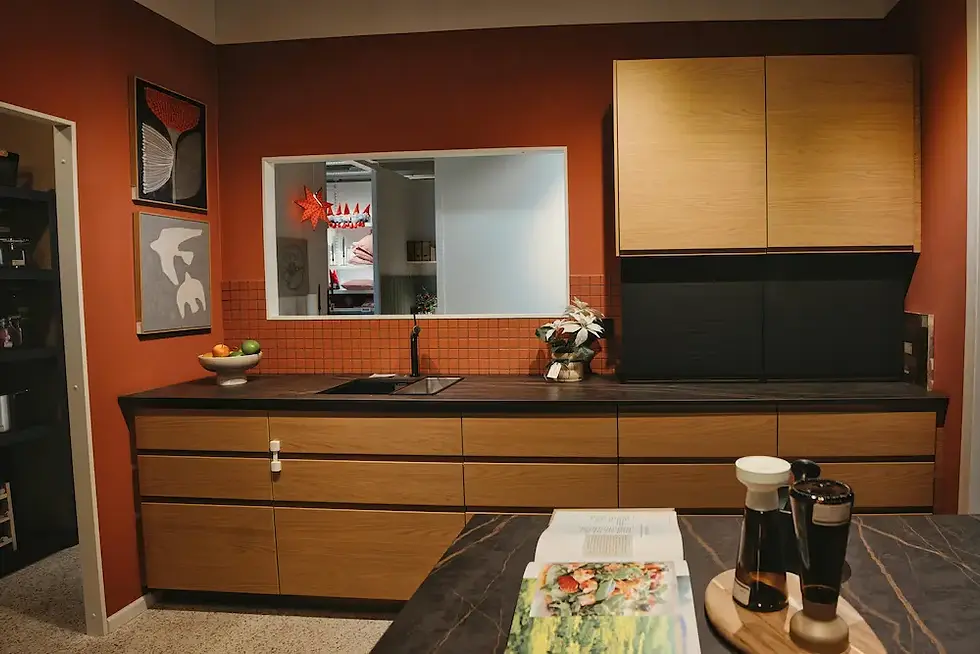
Warm Neutrals: Beyond Greige
Greige had its decade. In 2026, the warm neutral has moved toward colors with more body and less gray: "Oatmeal" (think Benjamin Moore's Pale Oak or Sherwin-Williams Accessible Beige), "Warm Linen" (a creamy off-white with the faintest terracotta undertone), and "Mushroom" (a taupe with brown warmth rather than violet cool). These are the wall colors that make wood floors, brass hardware, and natural stone countertops look like they belong together.
Heritage Hues: Sage Green, Terracotta, and Provençal Blue
These are not accent colors anymore they're full-kitchen commitments. Sage Green cabinets (lower only, with white or open shelving above) are the single most-requested kitchen color in 2026. Terracotta on a feature wall or island base brings Mediterranean warmth without overwhelming the room. Provençal Blue deeper than sky, softer than navy works on cabinetry, on a range hood, or as a full wall commitment behind open shelving. For deeper guidance on this specific direction, French Blue Interior Design 2026 covers every application and paint match.

The Japandi Influence: Limewash in the Kitchen
Limewash - mineral paint made from limestone, water, and natural pigment is the 2026 finish everybody wants and most people apply incorrectly.
What makes it work: limewash creates a cloudy, textured surface that shifts with light throughout the day. Modern brands like Bauwerk and Kalklitir are formulated with under 5% acrylic for easier application than traditional pure-lime formulations.
What makes it tricky in kitchens: limewash is inherently porous. Behind the stove and next to the sink, it absorbs splashes. The solution: apply limewash on walls away from the work triangle, and use tile or sealed surfaces in splash zones. Limewash on the dining-end wall of an open kitchen, on the ceiling, or behind the table is where it shines without the maintenance risk.
Application tip: limewash dries fast and must be applied in continuous, overlapping strokes stop mid-wall and the seam shows permanently. Work one wall at a time and keep a wet edge. For the broader design direction, 2026 Kitchen Design. Trends covers how limewash, natural materials, and heritage color work together.
How to Sample Paint Correctly (Not on Your Wall)
The standard advice paint a swatch on your wall is incomplete. A color on a white wall reads differently than that same color surrounded by your cabinets, countertop, and flooring.
Better method: buy sample pots ($5–$10 for 8oz testers) and paint them on foam core boards. Lean the boards against different walls next to the window in morning light, under the pendant in evening light, next to the countertop. Live with them for 48 hours minimum. Observe at 7 AM, noon, and 9 PM. This single step eliminates the most expensive mistake in kitchen painting: discovering you hate the color after two coats are on the wall.

Where to Spend and Where to Save
Spend on paint. Benjamin Moore Advance ($55–$70/gallon) and Sherwin-Williams Emerald ($65–$80/gallon) level better, cover in fewer coats, and last years longer than $30 paint. Two coats of good paint outperform three coats of cheap paint.
Spend on primer. A $15 can of bonding primer is the difference between a decade and a year.
Save on tools. The $8 roller frame works as well as the $25 one. Drop cloths, trays, stir sticks — buy the cheapest option.
Save on your "second color." In a two-tone kitchen, let the premium paint go on the cabinets and use a mid-range option for walls. Walls don't get touched, opened, or scrubbed cabinets do.
Quick Checklist: What to Ask at the Paint Store in 2026
Does LED lighting really change how kitchen paint looks?
Yes, dramatically. Most hardware store LEDs have a Color Rendering Index (CRI) of 80–85, which means they only show about 80% of your paint's true color. Under low-CRI lighting, Sage Green can read as khaki and terracotta can look brown. Specify 90+ CRI LEDs in every kitchen fixture before choosing a paint color, and test samples under your actual lights at morning, midday, and evening.
What paint finish is best for kitchen walls in 2026?
Eggshell is the minimum for kitchen walls in the working zone it balances cleanability with a soft, non-plastic appearance. Satin or semi-gloss is best for cabinets and trim. Flat or matte finishes belong on ceilings and accent walls only in high-traffic kitchen zones, they stain permanently and can't be wiped clean without pulling pigment.
Is limewash practical for kitchen walls?
Limewash works beautifully in kitchens but not everywhere. It's porous, so it absorbs splashes behind the stove and near the sink. Apply it on walls away from the work triangle: the dining-end wall, the ceiling, or an accent wall behind open shelving. Use tile or sealed surfaces in splash zones. Modern limewash brands like Bauwerk and Kalklitir include a small acrylic percentage for easier application and better durability than traditional formulations.
Should I paint kitchen cabinets myself or hire a professional?
Cabinet painting is the most commonly botched kitchen DIY project. A professional spray job costs $1,500–$3,500 and delivers a factory-smooth finish. A failed DIY attempt that needs stripping and repainting costs $2,000–$4,000 on top of the materials you already bought. If you do it yourself, never skip the bonding primer Zinsser BIN or STIX and plan for 3–5 days, not a weekend.
What kitchen paint colors are trending in 2026?
The all-gray and all-white kitchen era is over. The 2026 palette centers on heritage hues: Sage Green (especially on lower cabinets), warm terracotta, Provençal blue, and olive green. Warm neutrals have shifted from greige toward richer tones Oatmeal, Warm Linen, and Mushroom that pair naturally with wood floors, brass hardware, and natural stone.
Love our ideas? Let's bring them into your home. WarmCazza now designs rooms like this, remotely - your own concept, layout and shopping list. Explore E-Design →
About Nina Sajaia
Nina Sajaia is the founder of WarmCazza and has been writing about interiors, slow living, and the psychology of home since 2021. Her work on Japandi and Warm Minimalism has been shared across interior design communities in Europe and the US. She has assembled more IKEA furniture than she would like to admit and has strong opinions about which brands do it better.
This article was written by WarmCazza and is informed by current US furniture market research, assembly testing, and 2026 interior design trend analysis. © WarmCazza - All Rights Reserved.


Comments